
King’s Quest V: Absence Makes the Heart Go Yonder!
Written by: Stoo
Date posted: May 19, 2026
- Genre: Adventure
- Developed by: Sierra
- Published by: Sierra
- Year released: 1990
- Our score: 6
You’d think a site dedicated to classic PC gaming would have thorough coverage of the Sierra adventures, yet I must guess there are still substantial gaps in our archives. We’ve looked at all the Police Quests now and a good amount of the Space Quests, but only the first of the Quest for Glory series. Also so far we’ve only managed to make ourselves try a single entry in the Leisure Suit Larry series; I think eventually my curiosity will overcome our-long running disdain for those ones (but not today). As for the much respected King’s Quest though, first of all Sierra series, we’ve only reviewed a couple of examples towards its latter days. I found the sixth game to be quite enjoyable: an engaging story about a young man on a mission to save a princess. Jo seems to have been one step less enthusiastic about the seventh, although she still rated it as moderately good.
It’s still highly unlikely that I’ll ever go to the first games in the series. Honestly I’m not sure how to even adequately cover them in the style of review we do here, since any attempt will inevitably be pulled in two directions. I’d have to duly note to the enormous historical significance; we should all be aware of how the genesis of graphical adventures came about, right? Yet at the same time doubt I’d actually have much fun with it. My vague memories of attempt, over 10 years ago involve some sort of scavenger hunt in a samey-looking forest with minimal story. Then falling off a very small bridge thanks to a mix of clunky controls and awful collision detection. This incidentally was fatal. I think I fell about 3 feet into a moat?
So I have no idea how to draw a useful conclusion on that, and I’m not in a hurry to review other early AGI-powered Sierra games, with their keyboard controls, unforgiving natures and blocky pixel people. (I suppose I could try the KQ1 remake, but even with a bit of an upgrade it’s still a scavenger hunt in a forest). It’s fortunate then that our good friend the J-man is far better than I at drawing up a fair and accurate appraisal of truly ancient PC games – so go read the Sierra reviews at Just Games Retro.
There are however two King’s Quest games that neither ourselves nor JGR have yet reviewed. One is the eighth which moved to 3D action-adventure, as by the late 90s point-and-click games were fading and the age of Tomb Raider was upon us. I’ve filed that one away to consider another time, so instead today we’re looking at the 5th Entry: Absence Makes the Heart Go Yonder!
This was last in the series to feature original protagonist King Graham as the player character, and our story begins with him going for a pleasant afternoon stroll in the woods. While he’s off picking flowers however, something terrible is happening at castle Daventry. Some sort of evil wizard appears and casts a spell making the castle, with Graham’s family inside it, shrink and vanish.
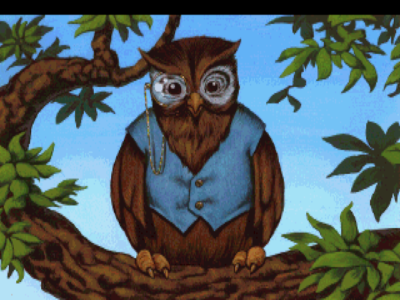
The intro looks great; it’s a shame shame poor Cedric turns out to be beyond useless.
So Graham returns home to find not his wife and kids but… an empty field. Begore he has time to despair though, a talking owl named Cedric appears offering to take Graham to see another wizard. This is Crispin, a more friendly and grandfatherly sort who offers Graham some guidance and hopefully useful magic items. Thus our king sets off with his new owl chum on a mission quest to restore his family and his home.
Released in 1990, KQ5 marked the debut of Sierra’s new SCI1 engine. That meant an upgrade from the EGA of old to 256-colour VGA graphics – a new standard which was only just starting to become widespread in PC gaming. It certainly does look lovely, with lots of those hand-drawn screens we came to associate with Sierra, showing forests and towns and mountains. The intro is impressive for the time also with several semi-animated closeups, and more are scattered throughout the rest of the game.
The artwork, and the sort of fantasy themes you encounter, do retain that kind of straightforward 1980s children’s-storybook style, which I’ve criticised in the past for being a bit uninspired. Enchanted forests, creepy witches, pixies, that sorf of thing. For examples of contemporaries with more striking aesthetics I could point to the more original fantasy of Loom. Even this game’s own sequel I think was a bit more visually distinctive, if only due to its whole patchwork quilt mix of different inspirations. Then again, I’m getting less cynical in my old age; this is charming enough and I’d happily read a storybook in this style to my kid.
SCI1 also means this was the first Sierra adventure to use a fully mouse-driven interface with zero typing required. (KQ4 was from a hybrid generation where you could the use the mouse, but only for looking at things and moving). In this regard they were playing catchup with Lucasarts who had been totally mouse-based since Maniac Mansion. Then again, the Lucasarts approach involved 25-30% of the screen being permanently hogged by the list of commands and inventory items. Sierra’s GUI disappears when not in use, letting you enjoy the graphics better.
There’s one more “first” that applies not to the original release, but rather the CD-ROM version released in 1991 or 1992 (sources seem to disagree on which year). It was sierra’s first “talkie”, using those 650MB of CD storage to add voice acting. Unfortunately this, is….. Yeah. It’s not great. Voice acting duties were carried out by the Sierra team themselves, with predictably amateurish results. Graham himself is borderline acceptable but most others go between dreadfully wooden, exaggerated “kindly old man” or someone doing an awful attempt at a talking animal.
You could say I’m going too hard on something from the earliest days of spoken dialogue in gaming. In which case my response would be, it’s not like the concept of a professional voice actor didn’t exist before this! Go try the talkie version of Loom from 1992 (that’s twice you’ve mentioned Loom now – ed), and compare to KQ5, the difference is night and day.
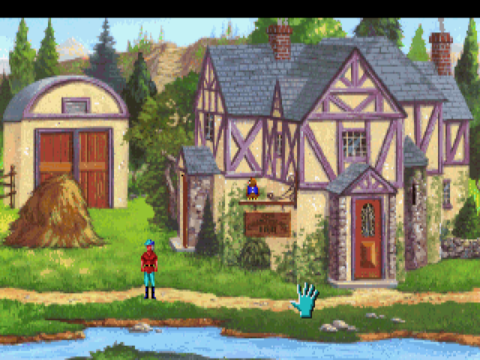
Anyway the game proper begins with Graham and the owl outside Crispin’s house in the forest (he’s not going to help you any further so don’t bother going back in there). Around this is several more forest spaces, each with some sort of resident to talk to or a situation to resolve, a little like the first game. A gnome family in one, a gypsy caravan in another. To the east is a quaint little town, to the west a vast desert, to the north a more evil looking forest that you don’t want to go in right away.
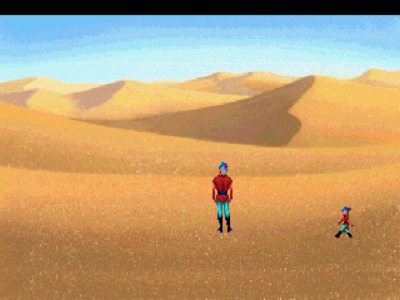
This part takes a while. Get your squared paper ready!
(It just popped into my head, there’s a practical reason the game doesn’t take place within Graham’s own kingdom. It’s so every NPC who isn’t a villain doesn’t just immediately drop to one knee, call you “my liege” and offer you any items you need. None of this would make sense if you were actually a king here.)
This part of the game is fairly non linear, you can accomplish goals and solve puzzles in any order, and it’s probably half the total content. The goal immediately afterward is to head up a mountain in pursuit of the wizard, and this part really acts as a check to see if you completed all the previous regions. From here on it’s a bit more focused and linear -a small number of screens you have to figure out, then onto the next set.
We do at some point need to discuss Cedric though. Look, again I’m a dad and thus a sentimental sort these days. Give me a talking owl in a little waistcoat, I’m all for it. Unfortunately, far from being a trusty sidekick he is in fact relentlessly unhelpful. In fact mostly he just gets in trouble and needs rescuing. He’s also saddled with perhaps the most irritating voice of all, a ridiculous falsetto. Thus he takes his place as gaming’s second worst owl, after that one who wouldn’t stop talking in Ocarina of Time.
Anyway, I’ve mentioned how this is a move into the more slick, point and click VGA days of adventuring. In the past I’ve mistakenly assumed that means also a slightly more forgiving approach to designing puzzles, as if the really tricky and confounding stuff was a relic of the EGA days. Space Quest 4 rudely disabused me of that notion and I can confirm that KQ5 is also full of the ways Sierra loved to torment and confound us.
I’m not even talking about the screens where you walk on and instantly get killed without any chance to respond, of which there are plenty. That’s easy stuff, just reload right? What I am talking about is dead ends, timed events, and illogical solutions it seems you would only ever discover through pure trial and error.
Let’s start with the desert – a big grid of sandy screens, mostly all the same. There are three locations scattered around with things you need to find, and a couple more with pools of water. You can traverse about six screens without dying of thirst. You’re not going to find everything in one try, so it’s time to get old school. I grabbed some paper and a pencil, and sent Graham on many suicidal mapping missions. Just to make your life more difficult, though, the desert has walls in two directions but then extends far beyond any points of interest in the other two. You just walk through baking, sandy emptiness until you die. So you can easily waste time mapping areas that are totally pointless.
Then there’s particularly fiendish puzzle in the starting forest, which I will try and talk you through without giving away the solutions. At one point there’s a brief event involving animals. You need to resolve this to get out of a dangerous situation later that is otherwise lethal. Here are the problems!
-if you don’t resolve the animal event then (you have about 5 seconds) congratulations, you cannot get through the dangerous situation and the game has entered an unwinnable state.
-you might not realise you even can get out of that dangerous situation. It does look like the game is trying to tell you “what you just did is a mistake, don’t get caught here”. But you need to get into the situation, then out again, to obtain items you need later.
-you might mistakenly think the animal event is just flavour, an animation for decoration, and thus not realise you’re meant to do anything
-while there are clues linking the event to the dangerous situation, they are subtle and easy to miss.
-what I’m getting here is, if you don’t resolve the event you probably won’t even know that you’re in an unwinnable state. You’re just left to blunder around hopelessly. That’s what made these dead ends so evil.
Elsewhere, well, sometimes answers to puzzles are straightforward enough, and potential dead ends easy to avoid. If you see a shiny thing with an obvious glint, and walk off without picking it up, that’s on you. Also if you buy a pie, you have the sense not to immediately eat it, right?
Although what you do need the pie for is the sort of ridiculous slapstick I apparently did not have the right sort of sense of humour to guess. I just had to find it through “try every inventory item until something works” trial and error. Also there’s a point a little before that where you do need to eat something, and you have two different foods on you. So I hope you guessed correctly to eat the other thing and not the pie. Otherwise, yes, you know what happens. It rhymes with “unbinnable plate”.
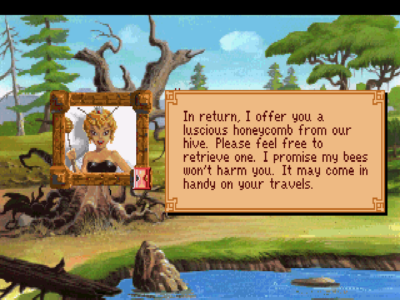
Happy to be of service, ma’am.
The endgame takes place in the Evil Wizard’s castle (not really a spoiler, surely). Once there expect a situation a bit like the one earlier where you’re thinking: ok I’m in a prison cell, was this meant to happen, can I get out or did I screw up? The answer is, infuriatingly enough you have to get caught but only exactly one time. While in the cell you need to get something to win the game. Miss it…. “unflingable weight”. Get yourself back in the cell again… “unspinnable fate”
Another highlight is a maze that’s tricky to map because your perspective keeps changing. Also, while I now know what to do to win, on replaying section I kept getting randomly zapped by the baddie and I’m still not totally sure why. There’s the blue monster you can (and must) stop once then hope you don’t see him again, a cat you have to deal the first time you see him but you can’t do that until you’ve stopped the blue guy, then you just want to avoid the wizard himself altogether until the very end. Simple!
So then, an adventure for the patient and thorough gamer. Throughout its run there there are situations where you think, how was I meant to know to do that? The answer is, maybe you weren’t. Back then you were expected to try anything and everything, just to see what worked. You were also expected keep a big long list of savegames in case of dead ends. Also you were probably expected get stuck and spend months figuring it out. After all back then we didn’t have huge steam backlogs. In our household in the early 90s we had maybe ten boxed games total, and I was a kid with a whole lot of free time to spend on them.
You might recall I came out of Space Quest 4 in a foul mood, thanks to its dead ends and obtuse puzzles. Funnily enough, this time I found the experience more rewarding. I think I was better prepared, and also gained some appreciation of why some gamers enjoyed this sort of challenge. Also to be honest I had uhs.com on standby. So by the end there is a sense of accomplishment. You’ve guided Graham through this long and perilous quest, and re-united him with his family. Well done, you.
Don’t get me wrong though, any newfound revelations of mine have their limits. 1990 is when The Secret of Monkey Island arrived, a witty and creative game that basically codified how Lucasarts would do adventures. Plenty of challenge, sure, but absolutely no dead ends. Certainly the greatest adventure of that year, and it thoroughly defeats this one. I should also point out the flawed but wonderful Loom came out around this time also (no one asked you about Loom! – ed). Or if even if we’d want to look just at Sierra fare, I’d put both KQ6 and Space Quest 5, both more forgiving, ahead of this one.
So I’ve settled on the score you see at the top as more or less aligned with my conclusions. It’s a worthy enough endeavour if you are patient, brought some squared paper and are not too proud to go look up some hints. Although it might help with your stress levels if you just google “mouse puzzle” ahead of time. Also, avoid the talkie version if you can.

 Posts
Posts
You did write it! Great stuff, as always. If you ever do go back to an AGI King’s Quest, try the third. Its time-based mechanics and “great escape” plot really do make it a different beast. And I don’t remember anything where you could fall off a staircase or bridge, which still sticks with me as the worst parts of early Kings Quests.
I have notes from 2018 of a partial KQ5 playthrough. They mention an “ant-based musical number!” which I now really want to see. But a ton of points on how you can get stuck, which almost seems like the biggest takeaway. I don’t know if Sierra just couldn’t design a different way to do adventures, or thought the LucasArts system was too easy and multiple saves (that you could even name to help remember) was enough.
Looks like I was playing the talkie version and have notes that they revised Cedric in that version. That he “takes a magic bullet for Graham and is then forgotten about until the very end. Everyone celebrates while his little owl corpse lays in the corner.” Apparently they also mocked him in later Space Quests? Seems like Sierra’s response to the Cedric hate was to pretend that, “oh yeah, he’s so lame, right guys? We’re in on the joke too!”
Somebody did a modern-modern King’s Quest didn’t they? Not the fan remakes, like a Telltale episodic game back when those were big?
Thanks for the review!
May 20, 2026 @ 4:46 pm
Yep that’s the one time Cedric is helpful, and it’s entirely by accident. Then once the baddie is defeated, they have their little reunion the prince meets Cassima to set up the sequel, and the Good Wizard is literally about to beam everyone home (4 minutes into the ending animation) before Graham says “oh yeah what about Cedric”. But honestly if I wasn’t playing the talkie I wouldn’t say he was *that* bad.
I wasn’t aware of the 2015 King’s Quest… that actually looks like something I could play with my daughter so thanks for the tip. (I mean I will try all this retro VGA nonsense on her one day, but I’m not getting my hopes up!)
May 21, 2026 @ 10:44 am
I’m a bit confused here. You write about:
* New, nice looking (but unoriginal) graphics
* Bad talkie version (avoid!)
* Annoying sidekick
* Chock full of death screens and dead ends just like in the early 80s
What are the game’s good sides which warrant the numerical rating of 6? Can’t just be the graphics.
June 10, 2026 @ 6:52 am
Scores are hand-wavy, subjective and dependent on my mood as much as anything else. I probably should have gone with 5.
June 10, 2026 @ 9:23 am
That’s fair enough 🙂 Your remark at the end of the review about aligning your view and the rating just threw me off.
June 10, 2026 @ 10:36 am