Hi there everyone.
Welcome to A Force for Good, where phrases like, “we’ll cover it one day” could mean a wait of several days, weeks, months or years for a planned review to materialise.
Anyway, tonight’s game is Cricket 96.
February 4th, 2018
Written by: Rik
Hi there everyone.
Welcome to A Force for Good, where phrases like, “we’ll cover it one day” could mean a wait of several days, weeks, months or years for a planned review to materialise.
Anyway, tonight’s game is Cricket 96.
January 27th, 2018
Written by: Rik
Hi there.
Football, football, football – when will it ever end? Well, in today’s review, we do have an ending, of sorts, as far as this particular series goes.
Here’s a look back at Pro Evolution Soccer 2010.
January 15th, 2018
Written by: Stoo
When interested in playing old games, you’re faced with a couple of practical questions: where do you find copies and, how are you going to run them?
For example you might be sticking to original hardware, trawling ebay for an old 16-bit console and some cartridges. Or you might be downloading files and running them on an emulator on a modern PC.
We’re now quite familiar with the issues in running classic games for consoles, for MS-DOS, and for old microcomputers. One whole other category of device though, that I’d never thought about before is smartphones and tablets. The first iphone games were released nearly a decade ago, that’s getting pretty old now. Give it a few years and they might even be retro.
Can we actually play them, though? It’s a concern that was brought to my attention by this tweet.
Eight years ago, Edge published their top 50 iOS games: the big hitters, indie breakthroughs, and most innovative ideas of the first wave of app development.
How many can still be found on the App Store today? 10 out of 50.#appocalypse pic.twitter.com/0LNbjd7pRB
— Chris Chapman (@retrohistories) January 11, 2018
With their app store, Apple brought us one centralised source and installation system for all our software needs. I do believe it was one of the really big advantages over earlier forms of mobile device (like the old PocketPCs). Yet it has a downside, in that it becomes a whole lot harder to obtain and run a game (or any other app) once it disappears from the store. A fate now suffered, apparently, by 80% of the top games of 2010.
You’ll probably have to jailbreak your phone, something immediately offputting to those who are not technically inclined. Then you have to find a download from some other source. Assuming the even runs on modern iOS. Similar problems apply for android devices, although they can at least sideload software without jailbreaking.
Many mobile games are, of course, freemium nonsense. There have however been lots of clever and inventive indie games too. I’m gladdened to see that the rather excellent Spider: Legend of Bryce Manor, is still available. I hope that in a decade’s time people can still enjoy Monument Valley.
In any case we might argue all the oldies should be made available in some form, regardless of quality. Even the mindless tapping games, the ones with barely any interaction, where your progress throttled unless you fork out $$ for some in-game currency. It’s a matter of preserving gaming history. Like ’em or not they have come to represent a major segment of gaming.
I wonder if some sort of online enthusiasts community will form, centered around old mobile games. A new counterpart to the abandonware scene of old. I just hope they are actually able to play those games.
I guess this topic has me thinking along similar lines to the when I asked “what is retro”. As time passes, and gaming progresses, so does our definition of “old game”. One day there will be 40 year olds reminiscing about stuff they played on their phone in their childhood, just as much as we here talk about Doom and Monkey Island. We all have our own little niches, but retro-gaming in general is not frozen in time.
January 14th, 2018
Written by: Rik
A recent non-existent survey of this site’s 12 readers revealed general disquiet about the amount of coverage of old football games. Well, we heard you loud and clear, imaginary reader – obviously cricket is more your thing.
When we were a bit more organised, it used to be possible to plan reviews around real life events in an attempt to be vaguely topical. So, as the real life Ashes series rolled around in November, the thought of digging out some dreadful cricket game for coverage did occur to me. Maybe even an Ashes cricket game!
And so I did dust off my copy of Ashes Cricket 2009, last played in 2009 on one of those rare occasions that I set aside my bargain basement sensibilities for a reckless new sports game purchase, and ignored forever shortly afterwards. Here’s a picture of Ian Bell.
It doesn’t look too bad there, does it? 2009-era Bell-y, sporting some blonde highlights under the helmet and a patchy-ish record, recalled once again on the basis of being better than Ravi Bopara. An Adidas bat as well, that’s right. And also you can’t really see any on-pitch action or anyone doing any cricket type movements.
When I first bought it, Ashes Cricket 2009 set a new personal record for the shortest time between installing and playing a new game and giving it up as a bad job and a waste of time and money. And now it also holds the record for the shortest amount of time spent considering a game for coverage on FFG before abandoning the idea altogether. Based on those five minutes, my review is: don’t bother.
A few years ago, I invested a lot of time in a dreadful cricket game, EA’s Cricket 2005, out of a misguided sense of commitment and fairness, a process that coincided with a summer of unrelenting migraine attacks which I now suspect must have been related. That review of Cricket 2005 could easily, I suspect, be applied to a number of other old cricket games: many of them make the same mistakes, and are seemingly made by people who think cricket is boring anyway and are honour-bound to give fans the dull action they crave.
(As a side note, things do seem to be getting better in recent years, with Big Ant Studios giving us the creditable Don Bradman Cricket games and the official Ashes tie in from this series. Apparently it’s quite good!)
There is one old cricket game that might be of interest, but kind of got away: Ian Botham’s International Cricket 96. Essentially a PC version of Super International Cricket, it was released in other places as EA Cricket 96, with one of the main differences from the SNES original being some very cheap and embarrassing FMV clips and commentary punctuating the action.
The additional twist with the Botham version was more clips featuring Beefy, in which he pretended to be in the studio doing links to the two actors from the EA version, even pretending that one of them was a real ex-player and commentator, which always struck me as a bit weird.
Sadly, I got rid of my copy some time ago and for some reason it hasn’t had a digital re-release (or indeed been a priority for, er, non legitimate purveyors of oldies). Maybe we’ll come back to it one day, but for the time being, well, maybe we could look at an adventure game or something? Or, er, football, anyone?
January 1st, 2018
Written by: Rik
Hi there.
We’re back with the Need for Speed series tonight, in our review of Need for Speed: Underground 2.
January 1st, 2018
Written by: Rik
Hi there.
Happy New Year to you! I haven’t quite decided whether we published enough reviews this year to actually bother doing a round-up [it hasn’t stopped you in the past – FFG reader] so I’ve come up with another way to cynically reheat some content from 2017.
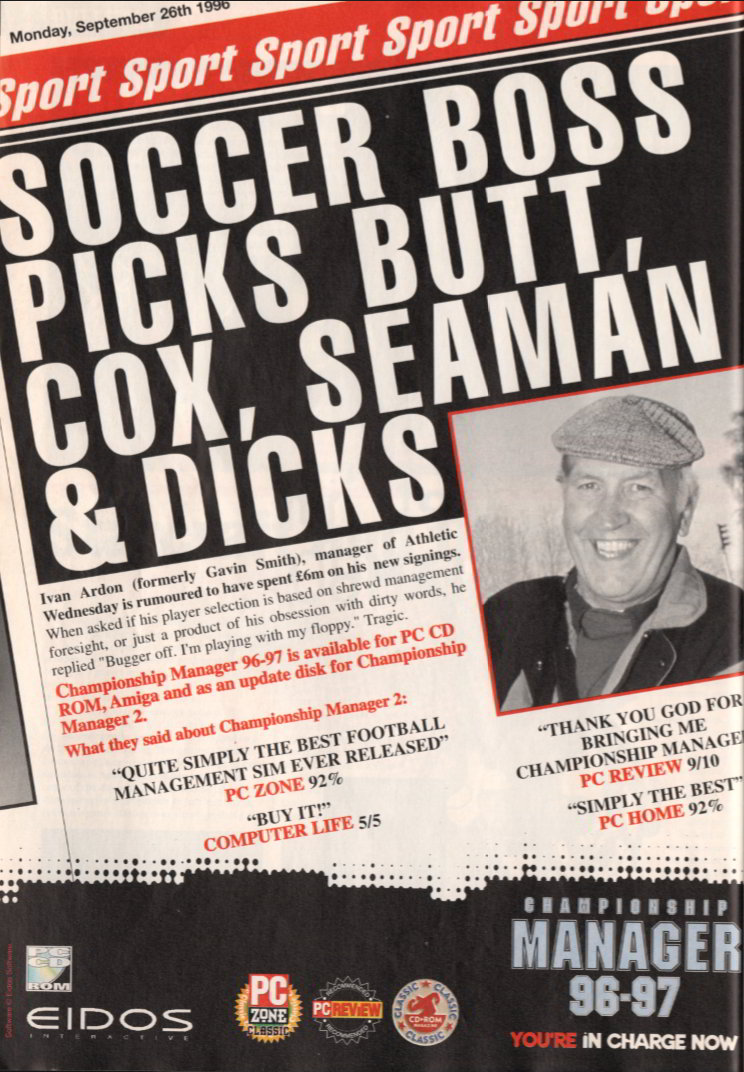
I guess our major feature this year was a look back through the pages of PC Zone magazine. And at various points, several adverts for games and gaming products caught the eye. So, if you can’t be bothered to read through our history feature, I’ve picked out some of the ads and put them in a list here. Because we all like a good, lazy, listicle at this time of year, right?
(It’s worth pointing out at this stage that this is not intended to be an exhaustive list of dreadful adverts: I’m sure there are many others. As for the worst one I can remember, well, you would have to go some distance to beat the notorious Jo Guest/Battlecruiser ad, about which my friend and colleague has already written before).
Here we go then, and in no particular order:
Catering directly to a schoolboy audience already familiar with jokes about ‘lobbing Seaman’, you’d hope that such tactics were beneath the venerable Championship Manager series, but obviously, they weren’t.
December 23rd, 2017
Written by: Rik
Hi there.
Season’s greetings to you all. Today we’re looking at the forerunner to our much-loved footy favourite of the 90s, Puma World Football. Here’s our review of Action Soccer.
December 20th, 2017
Written by: Stoo
Here at FFG, ScummVM is our emulator of choice for running old adventure games. To be fair, Dosbox works fine too. I just prefer ScummVM since it has a built-in GUI; I never got around to finding one I like for DOSbox.
It’s been around for about sixteen years now. Originally developed to run Lucasarts adventures, over the years they added support for Sierra games, and a bunch of others too. They’ve recently announced the release of version 2.0, which adds yet more games to the list.
Perhaps most significantly, you can now use ScummVM to play the the 32 bit sierra games from the mid 90s. These was their last batch of classic point-and-click adventures; after that they lost interest as the genre faded away. The list includes King’s Quest VII, which was trying pretty hard to look like a Disney Movie. Police Quest 4 was pretty good, even if it ditched our favourite Sierra hero Sonny Bonds for the mean streets of LA. Meanwhile Leisure Suit Larry 7 was a bit cringeworthy.
Going back over a decade earlier, to the days when they were known as On-line systems, there’s also support for some of Sierra’s pre-King’s Quest games. These seem to be of the sort based around lots of static screens – it was of course KQ that brought in the innovation of a little character you could control. I wouldn’t want to spend much time on such primitive titles myself, but, they’re worth including just for the sake of preserving that little part of gaming history.
Moving away from Sierra, and jumping back to the 90s, there are a couple of titles incorporating first-person perspectives and FMV. We have support for Starship Titanic, written by Douglas Adams and RAMA, based on the scifi novel by Arthur C Clarke.
There’s been some other tinkering on graphics and sound, so go read the release notes for more information.
December 2nd, 2017
Written by: Rik
Long-term readers may be familiar with our love for the largely-unknown football game Puma World Football ’98 (ancient review here, more recent discussion piece here). At various points during the late 90s/early 00s we occasionally wondered whether the game ever actually existed or was in fact the product of some kind of collective hallucination, such was the scarcity of available information.
In recent years bits and pieces have come to light, including several gameplay videos on YouTube. I was always puzzled that the mighty MobyGames didn’t have an entry for the game though. Or so I thought.
It turns out that the game was released in Germany under the title Sean Dundee’s World Club Football, and not only does MobyGames have an entry under that name, but also a scan of the box art (DIE FUSSBALLSIMULATION!) and some quotes from German reviews.
A search for that name doesn’t bear much more fruit, save for one or two lists of games with unlikely celebrity affiliations. For English football fans, the name Sean Dundee would be one of the last you’d expect to see plastered on a game box: he had a brief and extremely unsuccessful stint with Liverpool FC in the late 90s (his player profile on LFCHistory.net begins thus: “Sean Dundee has become a running joke among Liverpool supporters, considered by many as the worst-ever striker in recent times to wear the red shirt” and finishes with a quote from the manager who bought him, Roy Evans, “One player I do regret signing was Sean Dundee, he was terrible on and off the pitch”).
To be fair, Dundee did have a decent goalscoring record in Germany, so I guess for the German version to have his name on it isn’t that strange. Ubisoft eschewed a celebrity endorsement for the UK release, opting for a tie-in with a sportswear firm instead. *Checks Wikipedia* Oh, Puma is a German company, too! [How interesting! – a reader]
*EDIT* – Stoo pointed out that there’s also an entry on MG for World Football 98, which contains the following fun facts: in some countries, the game bore the name of another real-life footballer – Athletico Madrid striker Kiko Narváez (nope, never heard of him, although he seems to have had a slightly more illustrious career than Sean Dundee), and also at one point (apparently), a version of the game was given away with Danone Yogurts.
My eagle-eyed colleague also noticed that the entry for the Sean Dundee version of the game lists it as a DOS release. Were there two versions of World Football perhaps? I think possibly it might be a mistake – this page for Sean Dundee’s World Club Football, on a different database, has it listed as a Windows game. Ooh – and I just remembered something else – I think there was a patch that allowed you to play with international, rather than club sides, but it never worked with my version of the game.
Anyway, all this poking around for more information led me to revisit a long-held theory, which for reasons of incompetence or laziness I never followed up until now, that a wacky cartoon football game called Action Soccer was in some way related to Puma/Sean (no, I think I’ll stick with Puma). Turns out, I was right! [Hooray! – a reader]
I’ll write more about Action Soccer soon. For the time being, I guess this is an excuse to dig out a replay of what will forever be known, to a select few, as ‘the Peter goal’:
December 2nd, 2017
Written by: Rik
Hi there.
Our ongoing mission to rake through the bins of retro football gaming history continues tonight with a look at a Champions League tie-in from Krisalis.