[ Content | Sidebar ]

Skyrim!

July 24th, 2012

Written by: Stoo

So thanks to the Steam Sale I finally caved and got Skyrim. And am trying not to play for 6 hours every day. It doesn’t radically change the Elder SCrolls formula but continues to tweak and modernise it, whilst providing the same amazingly compelling sandbox style play.

So I’ll find myself on a mission to track down some enemy of the Thieves guild. But then I get see some Nord tomb, which takes the best part of an hour to fight my way through. Then I come out the other side and see some village in the distance that I’ve never seen before. So I trek there and sell some of the loot from the tomb. Then the blacksmith tells me they’re having problems with raiders, so maybe I should go check that out. Except there were also those funky Dwarvern ruins somewhere near here, weren’t there? Must be plenty cool to see there. Oh also the Thane of Makarth had a chore for me to do around here, trolls or something. And I was meant to be finding a book for some high elf douchebag at the college of Winterhold and I’m sure that’s in bandit hideout about ten minutes up the road so I’ll go do that first, maybe stop off at the silver mine along the way. Wait wasn’t I meant to be on that mission for the Thieves OH SHIT A DRAGON

So the Dragon fights are a new feature that punctuates your exp;oration. They’re amazingly well done, I’ve never seen an enemy that big and dynamic in an unscripted open-world type game. It’s more like something you’d expect in a contained boss-fight. They’re huge, they swoop around, they flamethrower everything in site while you cower behind a rock and think “ok tough guy, what now”.

So that’s Skyrim: 18 things to do at once, if I’m not just taking a walk in the hills to enjoy the scenery, then dragons happen.

Note that despite 20 odd hours play now, I’ve not even touched the central questline. I’ve done a fair bit for the Thieves guild, a couple of Mages Guild missions. Large chunks of the map are either unexplored, or have had points of interest bypassed with a mental note to go back later. The game is staggeringly vast.

re: modernisation, a key change is that character stats are reduced to a minimum, and now each skill has an assocaited talent tree. So on levelup I get decisions like, do I want some new sneaking-related ability like improved backstabs. Or a bonus to armour skill to boost mobility. Or the ability to craft more advanced weapons. I guess this is Blizzard’s legacy to gaming? (or did someone else think of Talent trees first).

Also I notice that weapons and armour no longer degrade and break. Perhaps thats a sign of being pampered modern gamers, but it’s not something I miss. The old make-your-own-spell feature I slightly miss, but again it was rather fiddly.

Anyways in an effort to tie this into retro-gaming, you could go read my thoughts on Morrowind. That review was arguably a bit premature, it was written when MW was only a few years old, before games 4 and 5 had come out. Looking back I can see how it feels somehow a bit bare in comparison. Well, the volume of content was there, but quests tended to be rather mechanical “go kill stuff and find an item” without so much scripting or storytelling. Also NPCs, unless key to some plot line, tended to be a bit generic, and stood weirdly rooted to the spot around the clock. Later games do a more convincing job of showing towns as places populated by living people.

That said I think it did well establish that addictive Elder Scrolls magic, the feeling of having a whole world to explore and find adventure in. It helped that it had a slightly mysterious, exotic feel – Oblivion, while a better game overall, was fairly generic High Fantasy.

So anyway i’m not getting a lot of retro gaming done right now, but as compensation the first feelers into creating FFG V3 are underway. By which I mean I learned how to bugger up wordpress templates. WAtch this space.

a tale of aching clicking fingers

July 19th, 2012

Written by: Stoo

Lately I’ve been getting the bad feeling that I’ve lost interest in action-rpgs. I say “bad” because it’s meant to be one of the topics I write about here. To be clear I’m not giving up on RPGs in general, just that click-to-kill sort, influenced in the past decade by Diablo 2.

See, last year I launched into Titan Quest, hoping for some monster-slaying fun. The sort that has you playing for hours, thinking “just one more dungeon” or “until I get a better sword”. Yet by about halfway through I was bored. It was a slog, endlessly clicking my way through one wave of goat-men after the other. Shoot lightning, they all fall down. Here come some more, shoot lighting again. Click click click. The reward for completing one section being… another wave of goat-men. And that staff with an extra +10 mana (or whatever) really not that thrilling a reward.

Then a couple months ago I fired up Diablo 2 itself again, with the aim of being vaguely topical and tying in with the release of the third game in that series. Now this is one I definitely played a fair bit back in the day, even if only tooling around on normal difficulty. Once again tho, it’s a slog. My character is stalled on act 2 after a few hours spamming the same few spells over and over and over. (if you diversify it weakens the character).

Recently picked up Torchlight 2. I like the art style, and it has some good ideas to add variety. Like, your characters are at first glance the warrior\ranger\mage archetypes, but in fact each can be figured to mix that up with other roles. The warrior can ehance himself with magic, the ranger can be more a melee-rogue type etc. However after a brief play it’s been utterly forgotten since I got Skyrim.

I can see where the appeal of these games is meant to lie: addictive gameplay that satisfies our twitch urges and basic effort-reward responses. Then on the slightly more intellectual side, the goal of putting together a great talent build to optimise your character. I mean, this worked for me, once.

Now though i can’t motivate myself enough to care. All these games feel like a tedious grind. I’m not sure if it’s a problem with the genre, or if I just got old, or what.

Anyway this is why you haven’t seen a Diablo 2 review yet. Sorry! Also I’m not in a hurry to play Diablo 3. Although I hear it lets you swap your talents around more freely? Which would help – I might be doing better in D2 if I could casually change my ice mage into a lightning mage, then back again, just for variety between dungeons.

It would be, it would be so nice

July 15th, 2012

Written by: Rik

Hello!

I’ve recently returned from a somewhat-deserved holiday, which was A Good Thing for all kinds of reasons. Without the drudgery of everyday life turning your brain into mush, a few days’ rest can see you gather together whatever scraps of creative thought remain up there and begin to regain the ability to form ideas and opinions. So, suitably refreshed, let me share some of my holiday thoughts with you (and apologies, but this is going to be a bit like one of those Christmas newsletters you get from relatives you don’t really know):

1) There’s a fundamental problem with handheld versions of games well-established on other platforms. If you buy one and like it, you can’t help but wonder if you’d like the ‘big-brother’ version more (and, given that the graphics, sound and controls are all likely to be better, that answer is likely to be ‘yes’). On the other hand, if you buy a handheld game because you want a portable, cut-down version of something you already know you like, it has to be pretty damn good to make you think something other than, “I already played this, and it was better the first time.” (Holiday example of the former: EA Fight Night; and of the latter: Midnight Club: LA Remix – both on PSP – and both perfectly enjoyable, incidentally).

2) Games that are called Splinter Cell or Syphon Filter, or otherwise involve sneaking around in the dark and being careful, are just not for me. Does this stop me buying them? No, it does not. My misplaced confidence arguably stems from the fact I once completed Metal Gear: Solid, when I had finished my final university exams and had nothing else to do. (I am sure Syphon Filter: Logan’s Shadow on PSP is a fine game – it certainly looked quite nice – but I’ll be buggered if I can get the hang of something that maps different controls to the analogue stick and the D-pad and expects you to remember them). Time for another eBay sale.

3) Retro Gamer magazine [one of a number of ‘holiday periodicals’ purchased for the express purpose of distracting me from the brutal reality that air travel is made possible by fuel and engines firing you into the sky, and not by magic] seems to have improved since I last bought it a couple of years ago. (This particular issue seemed to feature a number of articles or interviews recalling the days when hit home-micro titles could be spawned from a keen programmer’s bedroom, with one person responsible for each and every element of the game, and it was a look back I enjoyed, even if I only remembered the names and/or brief details of the games in question, rather than having particularly fond memories of playing them.) But, I can’t avoid the conclusion that it’s still not as good as it could be. With a wealth of potential material across all formats, and even taking into account that you can’t please everyone all of the time, I still think it could offer more.

4) Staying on the topic of Retro Gamer, it struck me as odd that they would plan a Kick Off series retrospective and then ask Stuart Campbell to write it. I’m a big fan of his work, but he’s hardly known as a lover of the games themselves – to the extent that he and series creator Dino Dini became involved in some undignified internet squabbling many years after the fact – so it seemed like a strange choice. And so it proved, with the resultant piece straining for objectivity but clearly written by a man for whom too much had gone before. And whatever your opinion on the ages-old Sensi vs. Kick Off debate, you’d have to be seriously crazy to argue that the series didn’t take a serious nose-dive after the first couple of games, anyway.

Epilogue:

Post-Holiday Realisation #1: There’s a Steam Sale on.
Post-Holiday Realisation #2: You can get a Steam app for your Android phone.
Post-Holiday Realisation #3: Danger! Danger!

If it’s in the game, it’s IN the game

June 24th, 2012

Written by: Rik

Hi there!

With all the excitement of Euro 2012, and on the eve of England beating/losing to Italy, we thought it might be time to add another football review to our archives.

So, finally, we have a game from the most famous football series of them all – the original FIFA International Soccer.

Mangle WON’T succeed!

June 10th, 2012

Written by: Rik

Hello everyone. We’ve got another discussion review for you today. If old platformers are your thing, take a look at Bio Menace.

Might be a few more discussions yet, hopefully looking at a range of types of game. If you’d rather read a “proper” review then don’t worry, those will remain the main feature.

The first set of discussions were complements to “important” games already reviewed. This second bunch meanwhile has a different focus; odds and ends that maybe don’t warrant an in depth review. Or we’re too inept to provide one (ahem, baseball). So instead we have fun comparing how well we did, bouncing questions off each other and maybe ruminating on the nature of the kind of game in question.

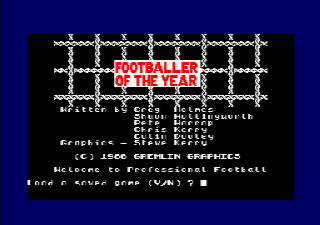
8-bit memories: Footballer of the Year

June 5th, 2012

Written by: Rik

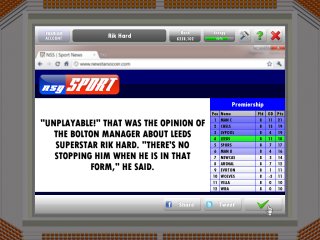
It’s funny when a game from yesteryear pops into your head for seemingly no reason. Well, I say no reason, but actually there was one: I was reading about a game called New Star Soccer, the point of which is to guide a single player from his humble roots as a 16 year-old trainee to the excesses of international stardom.

Innovative as that sounds, there’s no such thing as an original idea in this business, and indeed, Footballer of the Year promised largely the same thing when it was released some 26 years ago. (Sidenote: yikes! I’m old).

The structure of the game was extremely simple: you’d start with a limited amount of money and a small number of ‘goal cards’ – the means by which you could involve yourself in matches. It worked like this: before each fixture, you’d be told how many chances in that game a single ‘goal card’ would offer you (between 1 and 3) and you’d have to decide whether you’d want to spend a precious goal card in order to play in that game.

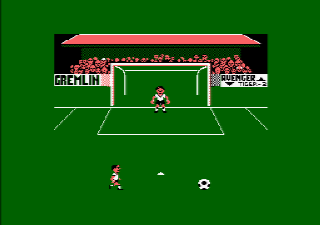
The taking or squandering of opportunities was then relayed via a fairly simple arcade sequence which basically amounted to lining up a shot and beating the ‘keeper (although if you hesitated too long you could also get tackled). Scoring goals not only helped your team win matches but also boosted your own profile, increasing your chances of securing a transfer to a more glamorous club (although, curiously, you also had to pay for these yourself by buying a ‘transfer card’).

There were also off-the-field ‘incidents’ – usually involving drinking, gambling, or the law – which would crop up every so often.

It was desperately simple stuff, although no less compelling for it. Once upon a time, I was one of a group of pathetic youths gathered around a Spectrum on a rainy Saturday afternoon as we took it in turns to play matches, using our combined skills to guide our player towards the coveted FOTY title (I don’t think we ever succeeded, although we got close).

There was a sequel, although it killed the spontaneous fun of the original by forcing you to memorise the contents of team talks and other players’ movements to have any chance of success in the arcade sequences. It’s odd that the idea hasn’t been revisited much since – although several games have given you the chance to play as one player on the pitch rather than as the whole team, there hasn’t been much that’s focused entirely on the ‘player aims to become a superstar’ angle.

With the football release schedule limited to the annual FIFA/Pro Evo bunfight, it comes down to the indie scene to offer a fresh approach. I’ve only just discovered the charms of New Star Soccer, but from what I’ve seen so far, it takes the core idea of FOTY and drags it into the modern era with some success (more on which, soon, perhaps).

*P.S. The tag ‘8-bit memories’ suggests that I may well write in vague terms about 8-bit games again. Which I might. But I also might not.

**P.P.S. Screenshots are from the Amstrad CPC version. Just because my friend had a Spectrum doesn’t mean I don’t like colours. Plus, sod the Speccy/C64 debate, the CPC was the best, etc etc…

Ewww…salty

May 27th, 2012

Written by: Rik

Hello there.

Well, well, what do we have here? After years and years of having precisely zero coverage of the series, here’s our second King’s Quest review in as many months. Just like London buses…(rest of joke deleted)

Jo’s the reviewer this time around, as she takes a look at King’s Quest VII: The Princeless Bride.

Sod off, Power Drive

May 20th, 2012

Written by: Rik

Hello.

It’s fair to say this latest review was rather more hard work than I’d anticipated – just goes to show that picking something that looks like it might provide simple, straightforward fun doesn’t always pay off.

Anyway, enough waffle. Here’s the review of the game in question: Power Drive.

of arty platformers

May 6th, 2012

Written by: Stoo

So I finally finished Limbo. My feelings are a bit uncertain.

Gameplay-wise it’s very well crafted. Given some puzzle it’s usually fairly clear what your overall goal is – you just need to figure out how to make that happen, from fairly simple elements (reversing gravity, a bear trap, some crates). The puzzles also feel like a part of the natural environment, not just something arbitray thrown in your way.

As for ambience and atmosphere tho… I dunno. The setting is basically a monochrome hell, a broken world containing little but lurking monsters and a few murderous survivors. Any sort of hope, or effort to survive feel futile in the cloak of damp, soul-sucking greyness. I get that this is quite deliberate – the game is called Limbo after all. But it’s almost too effective in setting the scene – it’s really a bit depressing. The style has plenty of merit, just not sure I want an entire game’s worth of it? Towards the end I found it a bit of a slog.

That’s just my subjective reaction tho, so I’m not going to call this any sort of “review.” Interesting to contrast tho with NightSky. Which is another game of silhouttes and physics puzzles. That one tho is somehow peaceful and restful. And it has some colours, those of late evening. And your “character” is more abstract, just a sphere and there’s no sort of death except for falling off the screen.

Anyways. I sometimes think we should keep more of an eye on indie games, particularly as many of them reference old-school gaming styles. Hipster physics platformers for one, of course. But also we’ve recently seen Legend of Grimrock, a tribute to RPGs like Dungeon Master, which mixes modern graphcs with that old style of flat square dungeon layouts.

Whether or not we’ll get into reviewing indie games, I dunno. Our review schedule is stately enough as it is. But still, if anyone has recommendations for particularly good ones with an old-school style, let me know!

All of this discussion

April 29th, 2012

Written by: Rik

We had quite a bit of fun last year with our series of discussion reviews, looking back at games we’d previously covered over the years. Ideally we’d have liked to have done one or two more, but these things take time, and ultimately we considered that going back and re-playing games we’d already covered, and dissecting what we’d previously said about them, wasn’t the best use of our time, especially considering our already, um, steady update schedule.

Since then, though, we’ve been toying with the idea of returning to the format in some other capacity – one that actually involves new content being posted to FFG. What we came up with, eventually, was the following idea: a regular feature, provisionally called “The Two-Week Review”, which would involve one or the other of us picking a old game (preferably abandonware) to be played over a two-week period, at the end of which an MSN discussion would be convened, hammered into a readable shape, and added to the journal.

Well, we’ve ditched the name, and the two-week concept, mainly to sidestep likely future embarrassment at being unable to keep to it (tellingly, our first attempt took roughly two months, rather than two weeks, to come to fruition), but we’re going to stick with the idea.

It’s not that we’re bored with the standard review format, or are running out of things we want to cover. The general principle is really to try and have a bit of fun looking back at some oldies that we might not have otherwise played, without necessarily worrying about producing a reasonably detailed review at the end of it. Plus, the experience of discussion retrospectives last year was quite an enjoyable one, and it felt pretty good to actually work on something together for a change, rather than simply using FFG as a shared dumping ground for our individual work.

We haven’t really set out any hard and fast rules. In fact, our first effort has actually been added as a review, rather than as a journal entry. In this instance, we figured we’d seen enough of what the game had to offer and covered most of what either of us wanted to say during the discussion. On other occasions, though, it might not be appropriate: it might be that we don’t feel we know enough about what a game has to offer at the discussion stage, at which point one of us might continue work on putting together a review, or we might just decide that it’s not worth any further time or coverage.

Either way, we figure that the worst-case scenario is that we have some new content, even if it’s just a journal post offering some initial thoughts on a previously-untried oldie.

Any thoughts on our first effort, or the idea in general, would be most welcome.