

Commander Keen in Keen Dreams
Written by: Stoo
Date posted: August 7, 2020
- Genre: Action
- Developed by: id Software
- Published by: Softdisk Publishing
- Year released: 1991
- Our score: 6
The Commander Keen series comprises some of the most noteworthy platform games to be native to the PC. It was an early creation of iD software – the guys who would later more or less invent first person shooters, and most of it was published by shareware champions Apogee. The series stars our eponymous hero, a genius kid with his signature American football helmet and pogostick. He travels the galaxy in his home made rocket, ready to defend the earth from fearsome enemies.
There were many instalments in the series, although most can be considered chapters of larger games. So we start with the first three Keens, released in 1990 which together make up Invasion of the Vorticons. An early display of technical wizardry, these were amongst the very first EGA games to feature smooth four way scrolling, something the NES had boasted for a few years already.
Next came Keens 4 and 5 in late 1991, together known as Goodbye Galaxy. For these two, iD developed an updated game engine. They made artistic improvements despite the limitations of 16-colour EGA to develop a charming, whimsical style, and added sound card support so we could enjoy some cheery background music. While Vorticons was a great achievement this was the more refined, polished product. I like to think it was a strong challenger to platformers on the more gaming-oriented systems.
(The last in the main, numbered sequence was Keen 6, Aliens Ate My Babysitter. It was more or less a third chapter to Goodbye Galaxy, but was released through a different publisher.)
That just leaves us with Keen Dreams, actually the fourth released, which goes by a couple nicknames amongst shareware fans. One is “the lost Keen” since it was published not by Apogee but another long defunct company, which has meant it’s been abandonware for long stretches since the 90s. That company is softdisk, previous employers of the iD guys. After releasing Vorticons they still had an oustanding obligation to create one more game for Softdisk. So, making the best of the situation, they used that requirement as a chance to test the engine that would later power Goodbye Galaxy. The resulting game’s nature as a protype, and its place between main named instalments lead to another nickname: Keen 3.5.
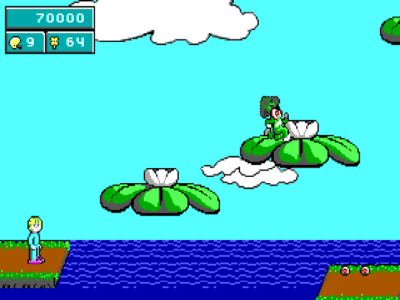
Some angry broccoli.
Instead of travelling through space, in this one Keen is sent to bed after refusing to eat his vegetables. He wakes up to find potatoes and broccoli are giving him worse problems than sitting on his plate. He’s in a strange land populated by overgrown, hostile veggies and, worse, they are kidnapping children with their dream machine.
About half of what I just wrote there is taken from the usual shareware cursory text description you get when you hit F1. Still, playing on the whole theme of kids hating vegetables is a decent premise for a platform game starring an eight year old. As for the dream aspect, maybe he really went to a magic land, maybe its just a regular dream and this can all be handily waved outside of main Keen continuity. (If that sort of detail concerns you).
If you’re familiar with the main Keen games, you’ll notice which of of Goodbye Galaxy’s upgrades feature here and which are not yet implemented. For a start, sloped surfaces are now possible, so it’s not just a world made of square blocks. We also have that slightly isometric view, which I think helps brings the levels to life a bit. It has the more lively and appealing style of sprite artwork too, although maybe not the detailed backgrounds of later keens. The climbable poles of Galaxy are introduced in Dreams too. However, you can’t yet scroll the screen up or down a bit by looking up and crouching, which can sometimes make falling off platforms more perilous. Keen also lacks the ability to cling onto ledges and haul himself up.
Some abilities Keen had from the very first game are changed also. The pogo stick is missing which is a little disappointing, since it was Keen’s signature feature, akin to Sonic’s speed or Mario’s mushroom fixation. My extensive research (I’m so dedicated, I even read the articles the wiki page references) tells me this was to make our hero feel weaker, which I suppose is legitimate enough. It also meant iD didn’t have to think as much about vertical motion.
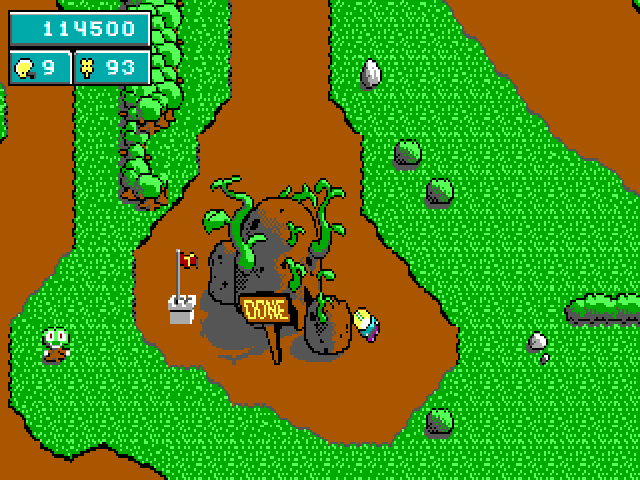
Map screen
His gun is gone too, apparently to make the game less violent. (Let’s not forget we’re back in the day when games were still seen as a kids’ pursuit). Instead you throw little pellets which temporarily turn enemies into a harmless flower. Knowing you only have about 10 seconds to get past can add some tension when dealing with, say, multiple enemies and tricky jumps. Also, since the pellets are affected by gravity, they can be harder to use in some circumstances. On the plus side, if you miss you have a few seconds to try and pick the pellet up again.
Your basic enemies are potatoes armed with spears. Some of the others are quite dynamic, each with their own distinct patterns of movement. Runner beans move too fast to “shoot” unless you respond very quickly. Apples can climb the same poles as you, and squashes will try and jump into you if you get close (tip: dash underneath). Add this to the limits of your new weapon and I’d say, overall, the enemies are a little trickier to deal with compared to Galaxy.
Your ultimate aim is to defeat the potato king, Boobus. To do this you must find special bombs scattered around the levels, used only in the final fight. A word of warning, it’s possible to complete a level without getting the bombs within; if you do that too many times you’d probably put the game in an unwinnable state.
Following another Keen tradition, levels are accessed from a map screen and you’re mostly free to tackle them in any order you prefer. There are only eleven in total, and at least a couple are very brief ones that exist just to unlock parts of the map. So it’s a fairly brief game in total. You could probably even skip a couple of the levels with bombs and still have enough the final fight.
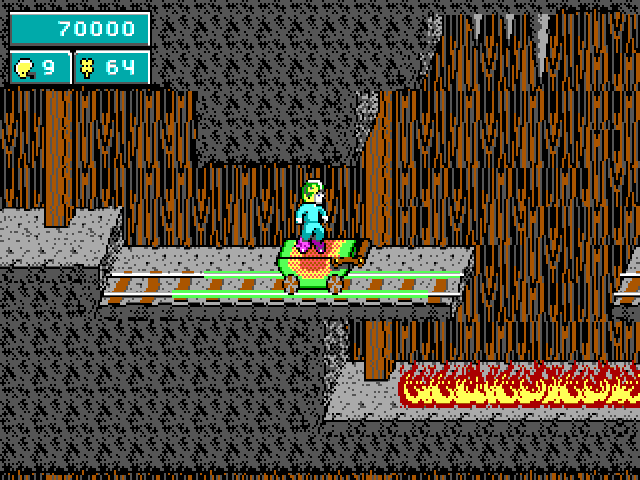
Not a lot of vegetables here, but I think that mine cart is a piece of melon.
The only thing really missing from Keen Dreams is some jaunty midi tunes to accompany your wacky adventures in the Potato Kingdom. Although sound cards are supported there’s no music; all you get are adlib chirps and trill for the sound effects. Apparently at least one tune was written, to go with an intro sequence, but it got canned to save space (since this was going to share a disk with other software). Titled “you’ve got to eat your vegetables”, it was saved for episode 4.
Overall Keen Dreams holds up pretty well. It puts a twist on the Keen formula and, while lacking in a few ways, doesn’t make any fatal mis-steps. Being as it is a test-bed, we shouldn’t expect it to be on a par with the fully fledged sequel that followed. I’m also not going to fall into my usual rut of trying to justify its existence in the face of platform games on the Megadrive. Instead I’ll just say, if you’re a fan of the shareware games of the early 90s, this one is worth a few hours of your time.

 Posts
Posts