
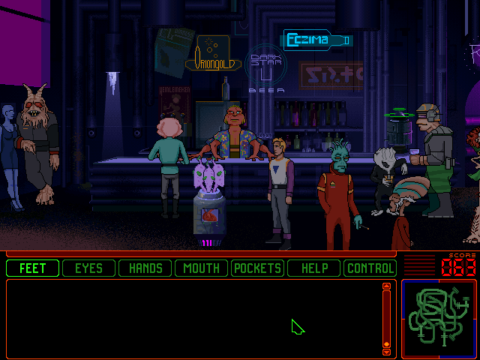
Space Quest 6: Roger Wilco in the Spinal Frontier
Written by: Stoo
Date posted: July 3, 2026
- Genre: Adventure
- Developed by: Sierra On-Line
- Published by: Sierra On-Line
- Year released: 1995
- Our score: 6
It’s odd to find myself feeling wistful, as I approach the end of a series I didn’t even care much about until the fifth (penultimate) entry. I think that, as I’ve occasionally tried to describe here, I have a strong attachment to the idea of Sierra adventures. A few of them made a strong impression on me in the formative days of my youth, and from then on I was always fascinated by the potential for storytelling, exploration and puzzle solving in all these different settings – fantasy, scifi, police work. (and, erm the middle aged pursuit of sex?).
That appeal, that call to step forward and be the hero of all these different tales, is something that persists even when the reality is often an exercise in frustration. I’m looking at you, Space Quest 4 with your stupid time pods and your stupid scene in the mall. Or you, Codename Iceman with all your baffling submarine stuff, which means I am unlikely to review you any time soon. Despite these setbacks the allure remains, and so I keep coming back. I’m glad to say, it does pay off sometimes – Space Quest 5 was actually quite good.
These are the things I find myself contemplating, Sierra’s role in gaming history and my own experiences, as we approach our last adventure together with Roger Wilco. In fact, The Spinal Frontier was one of Sierra’s last few traditional point-and-click adventures in general. Faced with the coming of 3D graphics and a push for more action-oriented content, the genre would fade from the mainstream within a few years.
You might recall the previous game was designed by Mark Crowe, one half of the “Two Guys from Andromeda” team who were responsible for the first four entries. Also it was a creation of Sierra’s subsidiary Dynamix. This one though, was brought back in-house by Sierra. Their employee Josh Mandel initially led development with the other Guy from Andromeda, Scott Murphy serving as a consultant. However partway through Mandel left, unhappy with the corporate culture at Sierra. Murphy was then left to finish it off.
Space Quest 5 saw Roger Wilco somehow managing to graduate from Starcon Academy and being promoted to Captain of a starship. That meant he was in the right place to uncover a conspiracy regarding unethical research gone wrong, and defeat the threat of the marauding Pukoid mutants. Unfortunately, his newfound status and responsibility is not to last. In the intro we see him being hauled in front of a court-martial for supposed transgressions (like losing the ship). Despite his heroic deeds, he is busted all the way back down to Janitor.
So ok, I get it? Roger’s life sucks, no good deed goes unpunished, har har. Actually it’s kind of disappointing. There was plenty of scope to tell more stories about Captain Wilco, a more seasoned but still occasionally hapless hero. We could have seen him managing the responsibilities of his command, screwing up once or twice then saving they day through a mix of bravery, luck and help from his slightly weary crew. Yet it was decided that no, the status quo must be ruthlessly enforced, and Roger must go back to being a second-class nobody.
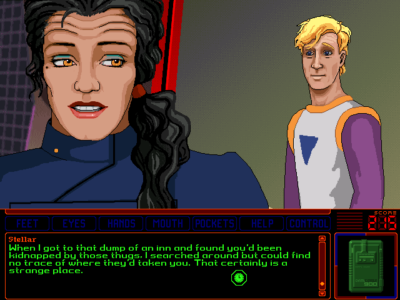
Our dorky hero somehow captures the eye of the heroic Stellar Santiago.
This also means that Roger’s crew vanish without a trace. As for Beatrice Wankmeister (sigh, yes, that was her name), the woman predestined to marry Roger and have his child (see: SQ4), she’s not in it either. Seems like there was no interested in moving that particular plot thread forward. However she does at least get mentioned mentioned a few times, largely because her existence causes complications for a burgeoning relationship between Roger and a new character, the dashing officer Stellar Santiago.
Following his demotion then, Roger’s new posting is to polish floors and mop up spills on the SCS Deepship 86. Our story begins with him beaming down to the world of Polysorbate LX for some R&R. It’s a parody of a scifi noir setting – grimy, neon lit streets and dingy bars. One of the main puzzles heavily references Blade Runner and Terminator. Yet at the same time the goofy Space Quest style is maintained through a bunch of wacky looking aliens you encounter.
It’s an effective start thematically, but there’s an odd lack of clear purpose. The end goal is to get a hotel room, which I suppose is what someone on shore leave might do, but neither Roger nor the narrator actually says this. Also, Roger’s quarters on the ship as you see later are surprisingly comfortable so why exactly does he want to spent a night in this dump? Anyway you do some tasks to get money, then go to the hotel purely because it’s the last thing left to interact with and you can afford it now. It’s a chain of events driven by what you can do without much explanation as to why you want to.
From here-on there are other points where the plot is unsatisfactory, as if scenes don’t quite connect together naturally. After the shore leave section Roger is kidnapped by some alien burly goons, and I’m still not clear why. We later find they are connected to the main villain, but I don’t recall any explanation as to why any of them are interested in our hero. As for that main villain themself, we find out their identity later but their motives and Evil Plan appear more or less out of nowhere in the last section with no real setup.
Admittedly you’re meant to be investigating a mystery revolving around the disappearance of another character. Still if you’d asked me halfway through what this game is actually about, I would have struggled to give a concise answer. SQ4 – much as I resented it, has a clear purpose: it’s about Roger being chased across time. SQ5 is about him trying to be a heroic Captain. SQ6 is just a collection of scenarios that occur.
It’s a shame because those scenarios are, individually, sound concepts with a good mix of themes. One part takes place aboard the Deepship 86, with Roger having to outsmart his own fellow crew-mates to steal a shuttle. So that’s your fairly conventional space-opera bit, with gags like a captain who’s a big cat, and a funeral that seems a solemn affair until you realise it’s a holodeck and the pastor isn’t even real. Another party sees Roger jacking into cyberspace – which basically looks like a bunch of impossible twisting roads, because this was 1995 and we were all talking about the “information superhighway”. To get in though, he has to argue his way past a secretary on a big Windows 3.11 desktop (your gateway to the early internet, of course).
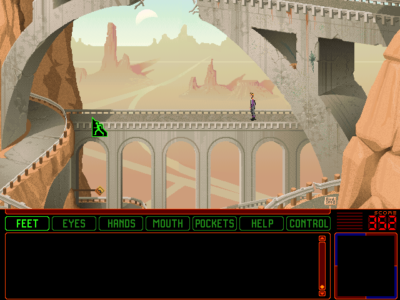
A trip into cyberspace.
Also, despite my grumbles about discarding the SQ5 cast, Stellar is a decent addition. The joke here is that, as a commissioned officer in a much smarter uniform, she’s clearly out of Roger’s league, so clearly our guy should be thanking his lucky stars (even if also trying to figure out how to fit this around his committent to Beatrice). Also being level headed and decisive I think contrasts her with his more messy, chaotic approach. Their dynamic is a bit like Dave Lister and Kochanski in Red Dwarf.
Except then things get a bit weird with her in the endgame. I don’t want to be too spoiler-ish so let’s just say the concept for these scenes is fine (another classic scifi reference), but some of the stuff Roger finds there just makes Stellar look like she has some really unhealthy habits. There’s zero context or previous clues to this discovery, and it’s at odds with her personality as we’ve seen so far. In the last cutscene Roger makes a weak joke about what he saw, which is kind of a narrative equivalent of laughing nervously and hoping nobody asks any further questions. Boy that was strange, huh! Roll credits!
Looking at something more positive, I’d say the artwork is decent enough. Moving on from the VGA generation of which SQ4 and SQ5 were members, the graphics are updated to a comparatively crisp 640×480. Characters and backgrounds look hand-drawn, while pre rendered CG is mixed in for objects like robots and spacecraft. It’s not on a par with the warm, cinematic styles of Broken Sword (surely one of the greatest adventures of this period) but it’s neat, clear and conveys the scfi settings effectively. We also get some closeups during important dialogue which helps bring characters to life, particularly Stellar. Voice acting is decent enough also, and the narrator is suitably sardonic.
What’s interesting though is the way the presentation of Roger himself has evolved. Originally he was a parody of pulpy sci-fi heroes like Buck Rogers, Flash Gordon or Captain Kirk, these being popular cultural reference points of the 80s when the first game was written. So he was broad-shouldered, square jawed and confident looking. This provided a humorous contrast with his job of pushing a mop around.
Here he’s skinnier – the intro reveals that he was previously wearing a muscle suit under his captain’s uniform – and narrower in the face. His voice is higher pitched and nasal than I was expecting (SQ5 lacked a “talkie” version, and I don’t recall how he sounded in SQ4). He’s also a bit snarkier than in previous outings. So he’s more of a 20-something underachieving everyman in a dead end job, making wry remarks as something else crappy happens to him. Maybe the writers wanted to make him more relatable to 90s audience? I say that more as just a observation than a criticism, except that the muscle suit does end up being one more middle finger to SQ5.
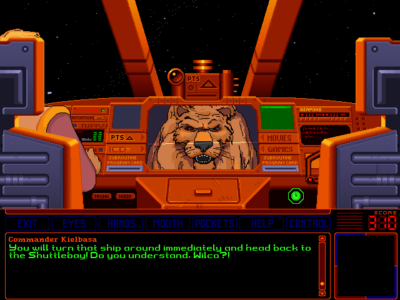
Roger steals a shuttle – although you need to figure out the fuel intermix puzzle first
Let’s move onto the puzzles; I found some of them to be pretty obtuse and it’s often unclear what you’re meant to be doing. So here’s a hint, when you look at a guy blocking your path and the narrator says “he looks a little Vulgar” that’s a pun – you’re meant to go look up a race called the Vulgars in the big database accessible at computer panels. I absolutely would not have figured that out myself. Also in that that bit where you’re catching the android early on, there’s no signposting as to what sort of solution you should try for. I could only blunder into it by accident, messing around with pipes and taps in the bar. (doesn’t help that they are faint background details surrounded by colourful aliens that are purely a distraction).
Also a couple of puzzles need you to pull answers from the manual. For example the infamous datacorder, where you have to re-arrange chips and circuit boards to make it perform a certain function. Ok sure, you do have the information to hand but you’d think that better design would put it into the content of the game itself (which, to be fair, was was Mandel’s original intent). It ends up feeling like a return to the thinly veiled copy protection of earlier adventures.
The good news is there are absolutely no unwinnable situations. King’s Quest 5 may have given me a new appreciation for the art of making many saves to protect yourself from dead ends, but I’m still happy to play a Sierra game that abandons the concept entirely. In fact, while we’re talking typical Sierra frustrations there aren’t so many places where Roger can get killed either, compared to older games. It can still happen but the threat is always obvious, something like choking gas or a big monster. You’re never punished just for being curious or clicking something that looks totally innocent.
Overall then Space Quest 6 does some things right. It takes a long-standing series, much loved by DOS gamers, and updates it to the expectations of the mid-90s. At the same time it maintains the amiable scifi parody through numerous references and the various mishaps that occur to Roger. Yet at the same time it’s all just a bit lacking, a disappointment when I had been hoping to end on a high note. We might plausibly blame some of the game’s problem on the troubled development – would the story have had a stronger sense of direction without the change of lead designer? Looking at that interview, Mandel seems to reckon the player at least have benefitted from a bit more guidance through the puzzles.
My scoring system for adventures is kind of a mess these days; whatever number I hand out is based on the mood a game puts me in, as much anything else. I should probably sit down and redo them all from scratch, based on a slightly more consistent set of criteria. Obviously this gets less than SQ5, the strongest entry in the series, but I would still rate it above SQ4 by a comfortable margin. It may have left me dissatisfied, but it didn’t have me furiously clicking “uninstall” the second I was done with it. I suppose that makes a 6/10? Maybe a 5/10. I feel bad giving anything less than 6 unless I actively dislike it.
So that’s it then, journey’s end. We finish with a Star Trek style view of flying through a starfield, while Stella speaks tantalisingly about a next mission that we never got to see. King’s Quest and Larry received re-imaginings over the decades but this was our last mission, save for unofficial fan games. Whatever misgivings we had about some (most) of the series, I suppose we should salute on of the PC gaming heroes of yesteryear. Second star on the right, and straight on ’til morning!

 Posts
Posts
Comedy and sci-fi should be two bullseyes for me, but I’ve never played a Space Quest. Maybe one day, though “SQ6 is just a collection of scenarios that occur” is such a brilliantly understandable description that it’s not making me excited for the series.
July 4, 2026 @ 9:53 am
I remember playing the demo of this and being confused about why Roger was still a janitor, figured it was some kind of storyline reboot.
Good work covering the series! I can safely now hurl my CD copy of the SQ Collection into the centre of the sun.
July 4, 2026 @ 9:56 am
I recall this as an absolutely horrenduous farce of a game. I don’t think I’ve ever sat in front of any other game thinking this frequently: THIS is supposed to be funny? Where is the joke in that?
Even on the surface, it’s such sloppy work. King’s Quest VII had shown that Sierra was well mastering the use of higher resolution graphics. And then, they come out with this, looking like someone’s just thrown together random elements from a cliparts CD. SQ 4 and 5 look so much better, it’s almost painful. Just look at this bar scene on your screenshot there. No sense of room, of scene. Or the bridge: the perspective of how is curves is all wrong.
Seeing how mildly positive you find it, I’m almost thinking I need to re-challenge my recollections there…
July 4, 2026 @ 4:28 pm
Mr C: I never really cracked up laughing at any of the series, they’re all the same level of mildly amusing and I didn’t see this as being any worse! Humour is of course subjective though.
The bridge might be deliberately wrong, that scene is meant to be a bit MC-Escher I think.
But anyway yeah, I didn’t think it was terrible. Just not great either.
Rik: sorry you’re not allowed to dispose of the CD until you cover SQ2 for us!
Jman: I hope you find time for at least one of two of the Space Quests one day, always interested to see your perspective. Who knows, maybe you’ll get on with them better than we did!
July 5, 2026 @ 9:20 pm