[ Content | Sidebar ]

Pre Half-Life shooters that aren’t System Shock

November 28th, 2015

Written by: Stoo

Our recent look at Outlaws had me pondering the early days of first-person shooters. The genre as we know it basically started with Wolfenstein 3D in 1992, and then went through a period of rapid advances. We progressed from the flat world of Wolf3d, to the two and a half dimension of Doom, to proper 3D graphics. We saw the first coming of hardware accelerated graphics. Multiplayer options emerged, using local networks and then the internet. There was also a lot of creative thinking, a variety of settings and themes, before the genre became dominated by grim-faced soldiers in drab contemporary battlefields or second world war settings.

There were a number of gems in these formative years, and I thought I’d list some of the ones I personally regard mostly highly.  I’ve placed the upper boundary for this period at Half Life, which through features like scripting and set-piece battles really set a whole new standard for implementing a narrative in a first-person shooter. So this is a list of the highlights up until that landmark. All of them except for System Shock, because I bang on about that one enough as it is.

Descent
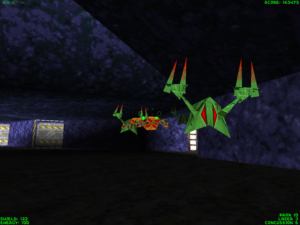
The choppy green bots are more menacing.
This one put you in the controls of a little spaceship, fighting killer robots through a series of mines across the solar system. Notable for being one of the first of these games to be true 3D in all aspects. So while most games of this era used sprites for their enemies, this one used polygons. Okay, to be fair, they’re fairly simple arrangements of blocks and wedges. Also though the level geometry is fully three dimensional, as opposed to the 2D sketch with bits raised and lowered that Doom used. So you can have one floor under another. Finally, your ship has six degrees of freedom of motion The setup could lead to some confused spinning around and bumping into walls at first, but with a bit of practise you could be strafing around giant chasms and hurtling down tunnels hammering robots with your plasmaguns. Actually it may have been easier to control with the mouse; for some reason I never really tried.

Also memorable for the frantic escape sequence at the end of each level, where you have about half a minute to find an exit before the reactor blows, with much swearing and panic along the way if you didn’t memorise the route ahead of time.


Hexen

hexen1
Raven’s first game to use the Doom engine, Heretic, was basically the same game with new levels and the chainguns replaced with magic wands. Fun but not worth a place on the list. Their second attempt however came with a bunch of new ideas. Firstly there are three playable characters, each with their own set of weapons. The warrior is a close range brawler – unusual for the first-person gaming. The more fragile mage likes to fight stuff at long range. The Cleric is somewhere in between and also has a rather ridiculously powerful weapon that basically launches angry ghosts.

Also, levels are now grouped around hubs, allowing you to move back and forth between them. To complete each set of levels you must solve puzzles, usually based on switches or finding items, to open up new sections, until you reach the final conclusion. The puzzles could get a bit frustrating – you’d often hit a button, see a text message telling you “a door has opened in the 7 portals”, and you then spend half an hour trying to figure out where. Still this aspect added some depth to the standard Doom template; there was a bit more to it all than just shooting monsters and gathering keys.


Doom

I love the way these things deflate like a mouldy raspberry when you kill them.

Doom came out around the same time as System Shock, and I sometimes see the two as having been in a competition where the superior title lost. Shock was the slower paced, more intelligent one of the two. It made more of an attempt a story, and had more emphasis on exploring and interacting with the environment around you. It also featured a more advanced game engine with features like sloping walls. Yet Doom, with its minimalist run and gun approach was the more successful, and the one the followers in the genre looked to. That’s why spent several years calling them all “doom clones”.

Except, I wasn’t meant to be talking about Shock today. So let me take off my Looking Glass Fanboy goggles, Doom was successful for damn good reasons. Picking it up to play nowadays, the action still feels perfectly tuned. You have the fast, fluid motion, circle strafing and ducking in and out of cover as you battle dozens of imps and demons. The shotgun is somehow still the greatest of its kind in gaming to date. The braying hell barons and tomato-monster Cacodemons are iconic foes. The maps are still creepy and ominous. Sometimes you don’t need anything more chin-strokingly clever than that, just fighting through waves of hellspawn to the  The soundtrack is basically a tribute to Slayer and Pantera rendered in midi. Then there’s the masses of user-made levels and total conversions to consider, which along with the multiplayer greatly prolonged the game’s active life amongst shooter fans.


Blood

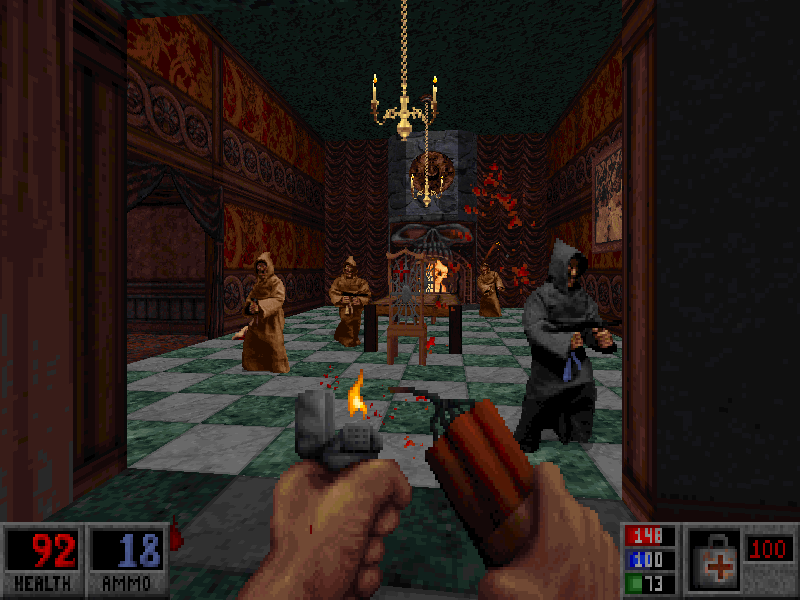
This situation can only end in kaboom.
I kind of feel bad for not putting Duke Nukem3D on this list. Really, I’m just more familiar with Blood, which used the same Build engine, and draws on horror movie themes the same way Duke was a tribute to action heroes. Our shadowy protagonist, caleb, starts the game literally rising from the grave, and must kill his way through all kinds of crazed cultists and horrible monsters, to find out why he was put there in the first place. It’s a game with a sense of humour, not afraid to throw in obvious movie references, and a stream of raspy-voiced one liners. Also, the game represents a time when levels were moving from the rather abstract corridors and rooms of Doom, to locations that look like they have an identifiable purpose, and thus feel more convincing. So here we have a train station, a carnival and a hotel that’s basically that one out of the Shining.

Blood was technically out of date at the time; it was one of the last not-quite-3D shooters at a time when Quake had called in a new era of actual 3D. Yet between the memorable maps, the outlandish and macabre themes, and the fun of setting monsters on fire with a flare gun, it more than compensated.


Outlaws

outlaws5
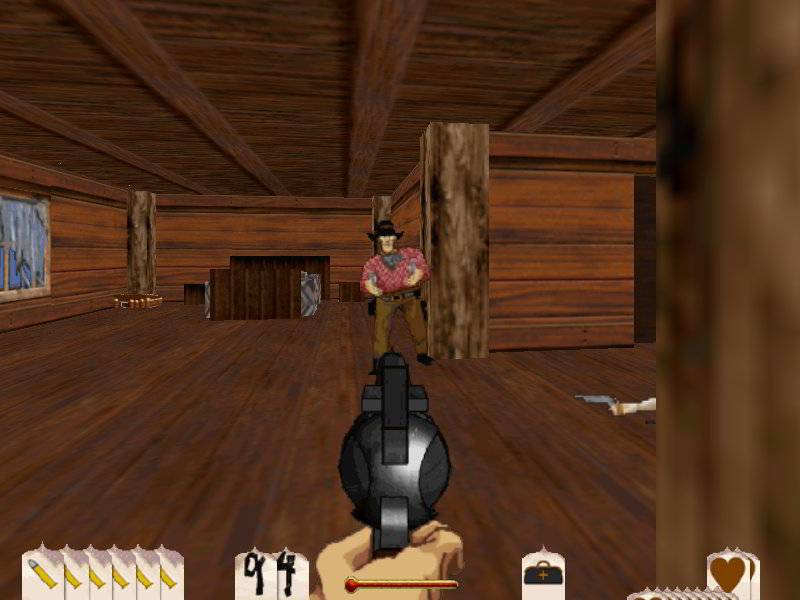
I’d never played this before our recent article, but it’s shot straight onto my list of favourites. It’s very much a pre-half-life, mid 90s shooter at heart – you sprint around shooting lots of fairly dimwitted goons in the face. Yet it has its own feel; you can die shockingly fast if you start taking hits, but there are no bullet sponge enemies either – they’re desperados, not cyberdemons. So the emphasis is on, suitably enough, being quick on the draw. Fast, accurate reactions are required.

Like Blood and Duke3d, the game manages some realistic looking maps despite being based on an old-fashioned engine. There’s sawmill, a fort and a small town with all the expected features like saloon and mortuary. Meanwhile, if you’re a fan of the old Spaghetti westerns, the music and artwork will make you feel right at home. The intro is something straight out of the Dollars trilogy. Meanwhile the animated cutscenes still look great, basically of the same standard that Lucasarts produced with their adventures of the time such as Sam and Max.

Unreal

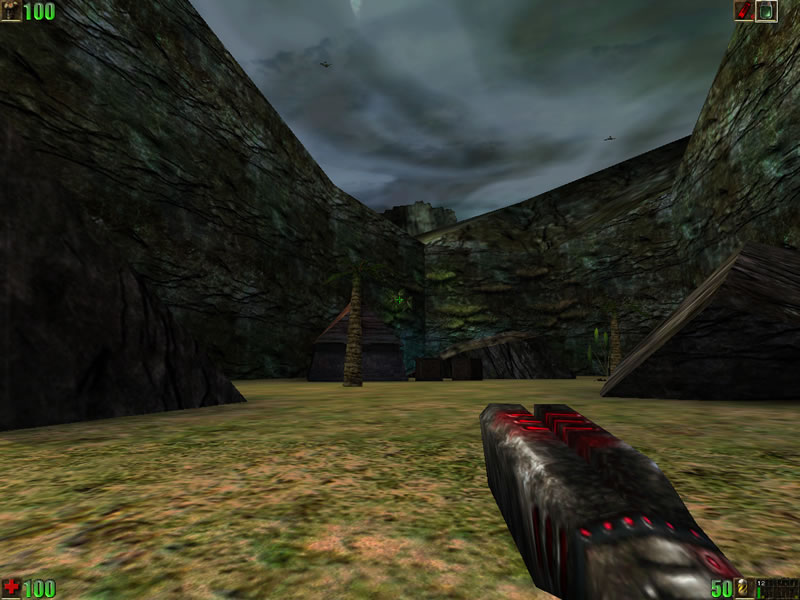
Stroll around a bit, enjoy the sights.
Perhaps the first shooter that truly showed me the benefits of the new generation of hardware-accelerated 3D graphics. The Quake series was technically advanced yet also relentlessly drab. Unreal however looked incredible – that first scene where you emerge from a crashed spaceship, into a verdant tropical paradise, is unforgettable. Looking back Unreal was a bit unsatisfying in some ways, particularly the weapons which felt more like colourful lightshows than anything substantial. Yet it’s exotic, alien, slight dreamlike world marks it as a highlight of this era.

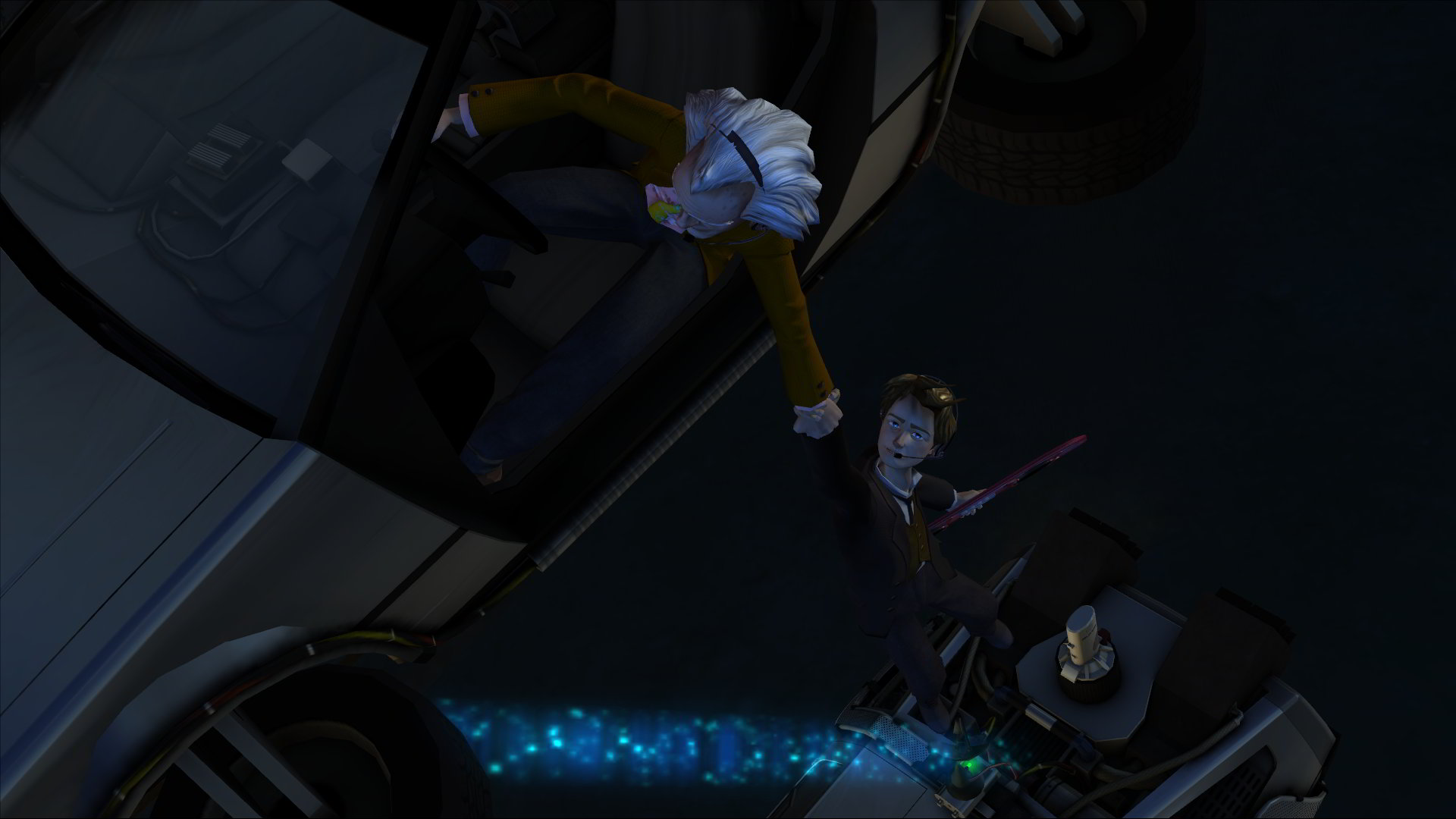
Tell me doctor, where are we going this time?

November 21st, 2015

Written by: Rik

So I just finished Telltale’s Back to the Future game. Despite having bought it in a fit of excitement upon release, I’d only played the first episode until last Christmas, at which point I declared that the very enjoyable second episode would mean that I’d be working my way through the rest at the earliest possible opportunity.

I’m not sure what happened to that plan – it’s taken me nearly another full year to get around to revisiting it – although I do think it’s possible that the sense of closure provided by the ending of each episode does provide an excuse to put the game down, in spite of effective use of cliffhangers and during-credits teaser trailers.

tellmedoctor

Anyway, I’d say I definitely enjoyed it overall. The story isn’t without the odd misstep, but in general it feels very faithful to the spirit of the movies. One of the central tenets of the original film was the question of what your parents were like when they were your age, what it would be like to meet them, and whether you’d be friends. Cue lots of Marty hanging around with the teenage versions of his parents.

For various reasons the film sequels went in a different direction, but the game revisits similar territory by having Marty go back to the 1930s, befriend a teenage Doc Brown, and make sure that his scientific career doesn’t go astray. (While Christopher Lloyd does feature, incidentally, he only plays the 1980s version of Doc and beyond – young Doc is voice by James Arnold Taylor, and a good job he does, too).

Although the Tannen dynasty is present and correct, along with older McFlys – mainly grandfather Artie – the game does have some other ideas when it comes to the primary antagonist, meaning the trope of one Tannen or another being the main source of trouble is, thankfully, broken.

For some, it may feel a little unnecessary to keep revisiting these characters and contriving new situations for them to sort out, and not everyone’s expectations will be met. Others will complain about the low level of difficulty, although it’s definitely an exaggeration to say it’s merely a case of just pushing a button to continue the story.

However, I reckon you’d have to be particularly hard-hearted not to engage with it at all, even if only out of plain nostalgia and love for the films: I even bopped along to Huey Lewis and the News during the end credits. (Yes, I said ‘bopped’.)

welcome to my death machine, interloper

November 18th, 2015

Written by: Stoo

Recently I took 10 mins to play a bit of the newly enhanced System Shock. Some observations:

Most importantly we have the option of mouselook. Shock was originally lumbered with clunky controls, where the mouse moved a pointer around the screen, and you had to click in certain places or use the keys to turn, or look up and down. It makes all those simple acts like moving around and looking at stuff just that little bit more difficult. Now though, the crosshairs stay centered and the direction in which you’re looking changes as you move the mouse. Just like a modern game.

You’ll still need the old system occasionally, to use the inventory interface or throw a grenade. Just hit the E key to toggle between old and new controls. If like me you prefer mouselook with the Y-axis inverted, there’s no option in the game itself, but just go into controls.cfg and set the y sensitivity to a negative value.

shockenh

We also have some new options for graphics resolution, where previously the upper limit was 640×480. You can have 854×480, which is only a modest improvement on before, but it is a proper widescreen mode. Or you can go to 1024×768 with black bars either side. So basically you can have widescreen, or significantly sharper graphics, but not both. Which is odd. However I’m not a programmer and I have no idea what sort of work had to be performed on this old engine. Perhaps it’s like coaxing an old and temperamental piece of machinery back to life? Or summoning a recalcitrant demon?

Anyway Like RT said previously, the Enhanced Edition isn’t bundled up with Dosbox but instead somehow runs natively in Windows. I didn’t notice any problems running it under Win10.

Apparently the keys can be remapped, but I’ve not noticed anything else worth mentioning. So this is still System Shock as we remember it, just with a few adjustments for the modern gamer. I only spent a short while roaming the blue-panelled walls of the medical deck, soaking up the atmosphere, but hope to find a spare weekend to revisit Citadel Station properly.

Look at that! Look at that!

November 17th, 2015

Written by: Rik

Lewis Hamilton features in a regular column for BBC Sport Online. I’m not desperately interested in him, or F1 in general, but I have kind of a long commute and there comes a point at which I end up reading every article on the BBC website.

Anyway, in a recent piece, hidden amongst the tales of his jetsetting lifestyle, and in the context of looking forward to the Brazilian Grand Prix, was this unexpected mention of retro gaming:

“When I was a kid, I used to play a game called Grand Prix Two. Interlagos was always the first race of the season on that and I never really got much past the second race…I would always restart the season, so I always seemed to be doing Interlagos – it was a real pain!”

The game Lewis is referring to there is Geoff Crammond’s Formula One Grand Prix 2. He’s also identified the precise reason why you won’t see many F1 games reviewed on FFG, because the above describes my experience with almost every one I’ve ever played. At best, I manage to get really good at one race before giving up: at worst, I don’t even get that far.

f1gp2

Still, it’s good to know that the current F1 world champion once had exactly the same issues as me. [Er – he had these problems with an F1 game when he was about 10 years old. Now he’s the world champion of the real sport, while you still struggle with the games – how are you similar, exactly? – FFG reader]

Strate-go

November 11th, 2015

Written by: Rik

I promised I’d look at a strategy game this year, if only to contrive some level of variety in my output, and not just an endless cycle of old football games and vaguely obscure hover racers.

So far, it’s not going that well. The game I had in mind was Republic: The Revolution, a political strategy title from the mind of Demis Hassabis, who worked at Bullfrog – most notably on Theme Park.

I’d taken some confidence from my earlier revisiting of the Football Manager series, in that it was a game that could seem overwhelming if you tried to work everything out by endlessly rereading the manual before you started, but wasn’t too bad once you actually took the plunge and started playing.

Our glorious (and clueless) leader

Our glorious (and clueless) leader

Admittedly, I was helped in this regard by countless hours spent with previous iterations of the same game, but I thought I could apply this approach to a strategy game of my choice: rather than being simply petrified of starting, I wouldn’t fear failure, and work it out as I went along. Plus, I have a politics degree, and some level of interest in the subject, so it couldn’t be that hard, right?

I’m not going to review the game by not reviewing it, and my thoughts are based on limited (and nowhere near enough) play time. However, all I can say is that I devoted half a day to Republic, in a relatively open minded and calm mood, seeing as I was off work and not trying to cram the game in on an evening or at a weekend, and emerged none the wiser. I wasn’t cross, or frustrated – just confused. Things were happening, but I didn’t know why, really, although the on-screen advice sort of made sense in isolation, I didn’t really figure out what the game actually involved.

Plenty going on. I think it's all gone wrong.

Plenty going on. I think it’s all gone wrong.

There was a cut scene involving some military types going into a house and gunning down some innocents that was quite juddery: I remember at the time there was a lot of Edge-magazine-type bollocks (possibly in Edge magazine) about the fab-whizzo graphics engine and what it could do, but then when the game came out it seemed there was little point in it at all. The main bits I enjoyed were the superficial ones at the start: the quiz where you work out what kind of leader you’ll be, and naming your party.

In short, I gave up. It could have been my fault, or the game’s, or a combination of both. This isn’t a rage piece where I invoke pantomime anger at my own stupidity or the game’s lack of clarity in some areas. But I’m going to have to leave it there. As a result, my confidence in such matters has been knocked slightly although some contemporary reviews suggest I probably shouldn’t be too hard on myself.

Anyway, I need to find an alternative – requests or suggestions are, as always, most welcome.

Move move move (The Red Tribe)

November 7th, 2015

Written by: Rik

Hi everyone.

Sometimes I just get the urge to play a really old football game. Most of them are quite bad, really, but there you go.

Today’s review is of Manchester United Europe.

mueuropetitle

You kill a few men before a jury gives you permission to, and they fire you

October 30th, 2015

Written by: Rik

Good evening.

October seems to be a fairly productive month for us at FFG. No, not because it’s Halloween. (You know, that really isn’t such a big deal over here).

Anyway, it’s been a little while, but we’ve got one of our discussion review features for you tonight. The game is Outlaws. Yee-haw! *fires guns into the air* (sincere apologies).

outlawstitle

The fastest game on Earth

October 23rd, 2015

Written by: Rik

Hi everyone.

I seem to be on a bit of a roll with these futuristic racers. Here’s another one for you: a game called Ballistics, from 2001.

ballisticstitle

Thank goodness for Stoo and his Duke Nukem retrospective! Next time: something completely different.

I’m Back

October 14th, 2015

Written by: Stoo

Hello everyone. A lot of my retro gaming time lately has been eaten up by a vast, sprawling 90s cRPG (I’ll leave you to speculate on which one), the sort of one that could take months yet to finish. I could cut it short but kinda feel like I want the full, beardy, dicerolling experience.

So I’m trying to fit in a few others along the way, the sort that aren’t such a massive commitment. Today we’re going back to the Apogee lineup, looking at the first couple of installments in the Duke Nukem series, back in the days before he went 3D and started hanging around strip clubs.

Damn, damn und blast

October 3rd, 2015

Written by: Rik

Hello.

Another day, another review, another future hover racer thing (but, you know, from the past). It’s Slipstream 5000.

slipstreamtitle