
Powerslave Exhumed
Written by: Stoo
Date posted: October 26, 2026
- Genre: Action
- Developed by: Lobotomy Software, Night Dive Studios
- Published by: Night Dive Studios
- Year released: 2022
- Our score: 7
Many years ago I wrote about Powerslave , a first-person shooter released in 1996 and powered by the Build engine. The setting is Karnak in Egypt, where mysterious alien forces have taken control. Seeking magical powers from the body of Pharoah Ramses, they’ve unleashed a horde of monsters from ancient mythology. You are one of a crack team of tough guy special forces soldiers sent to investigate the problem, except of course your helicopter gets shot down and you’re the only survivor. So it’s up to you to defeat the alien threat, guided by the spirit of Ramses who has been so rudely awoken from his eternal slumber.
Incidentally, while I can’t find a direct quote, the title is an obvious reference to Iron Maiden’s 1984 album and its Egypt-themed title track. Cranking it up while playing this may enhance your experience! (I don’t wanna die, I’m a god, why can’t I live on!). However the game was renamed Exhumed in this country – I’ve no idea if that was down to the legal problems or just a marketing decision.
Anyway, soldiers machine-gunning jackal-headed guys in pyramids should be a solid premise for shooter, right? Like something out of Stargate (the movie came out about two years before this). Unfortunately though, Powerslave was all a bit run-of-the-mill. Other Build games had humour, wisecracking heroes and clever levels packed full of detail. Quake meanwhile was taking the genre from the 2.5D of old to proper 3D. Amidst that competition, Powerslave failed to stand out, hence its relative obscurity and also my own lukewarm review. (not that I was personally impressed with Quake either, but that’s a topic for another day).
I’d heard though that the Saturn and Playstation versions were another kettle of fish, differing from the DOS version in a couple of fundamental way. They used a more advanced 3D engine called Slavedriver, created in house by the developers. Also, instead of a straightforward linear set of levels, they were more like a Metroidvania in structure. This sounded worth further investigation, but for many years they weren’t available on PC unless you used emulation.
That all change a few years ago when those heroes of retro gaming, Night Dive Studios, acquired the rights to re-release Powerslave. They took the console versions, which apparently were not quite identical (even if closer cousins than the PC version), and combined the best features of both into one game. Then they added the upgrades we’d expect from modern remasters – hi-resolution graphics, widescreen support, mouselook controls etc. The end result was Powerslave Exhumed, released on gog and steam. It’s a situation just a bit like Doom 64 – a recent Windows Port of the Console version of a DOS game.
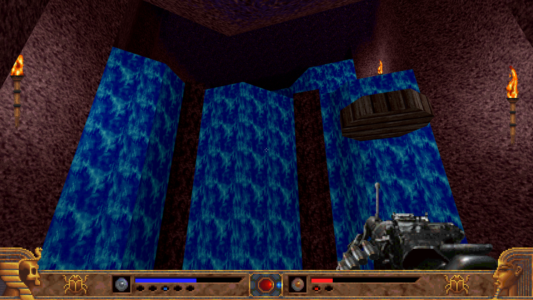
It’s not all sand and tombs, some levels have a lot of water. You probably want to get up there somehow.
Before we proceed, a couple of admissions. Firstly, it’s been many years since I originally played the DOS version and I only had time to briefly revisit it. As for the console versions, I have no experience of them at all. So this isn’t quite the thoroughly researched back-to-back comparison you might expect from a full-time social media gamer person.
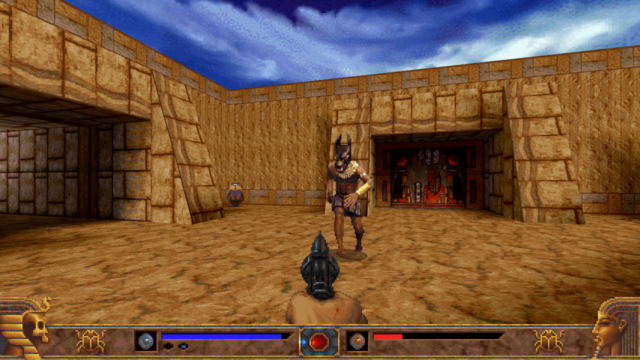
Also, I belatedly realised the game’s built-in screenshot function is really janky. About 70% of what it gave me was corrupted in various ways. After fighting with it some more for one good shot of an Anubis guy I gave up. So the rest of what I have isn’t the greatest representation.
That’s not a great start to a review, is it? Let’s move on though, because I do always enjoy sitting down to a 90s shooter. So then at very first glance PE is all familiar enough from the DOS game. You’re in various locations like desert canyons, ancient palaces and tombs. There’s a lot of sand, stone and blue skies. You start with just a big knife, chopping at jumping spider things, but soon grab a pistol then later a machinegun.
The first change I noticed was that weapons don’t shake the screen or push you with recoil when fired. Just a small detail, but it did make them feel weightier. Here’s another: there’s just one universal ammo pickup. Each weapon still has its own separate ammo supply, you just have to change to the one you want to replenish before you grab the floating blue orb thing. It’s not exactly a hassle, just an odd design choice.
A couple of oddities then, but there are more significant divergences from to the DOS game. In particular, the Slavedriver engine allows for more complex and realistic level geometry. If you think back to the Build or Doom engines, each level was basically was built out of two-dimensional sectors, extruded vertically to give floors and ceilings. That’s why they’re limited in what’s possible in the vertical direction – each sector can have a different floor height (or in Build, a sloping floor), but there cannot be more than one floor. Same goes for ceilings.
Slavedriver however allows for multiple floors at any location, and the game put this advantage to good use. It can have something as simple yet effective as bridge over a high canyon, instead of needing to make a solid wall down to ground levels. You can also have impressive-looking palaces with multiple floors, high galleries above big chambers, and tunnels down to treasure rooms directly underneath.
(sidenote: this is all meant to be set in the present day I’ve no idea why these places are so intact – did the aliens bring builders with them? Was the game originally meant to be set in ancient times?)
On another engine-related note, you now get dynamic coloured lighting – an Anubis-guy’s fireball will light up the room as it travels through. I’m pretty sure that’s new to the remaster; since the build engine couldn’t do that and I doubt the old console games could either. As well as adding atmosphere, it’s a good example of a way to tweak an old engine without straying too far from the original experience. Turning the enemies into new 3D models, for example, would be a step too far, but a bit of lighting is just the right amount of enhancement.
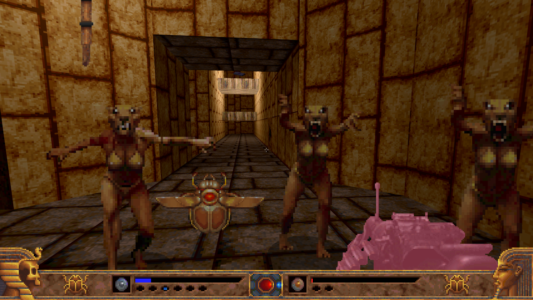
Release… the kitties!
Let’s move onto the “Metroidvania” bit. As you progress through levels you gain items that bestow new abilities upon you. One greatly increases the amount of time you can hold your breath underwater. Another boosts your jumping height. Apart from the generally useful enhancements to your mobility, once you have these abilities you can backtrack to earlier levels (reached through a joining map screen) and use them to reach areas that were previously completely inaccessible. This often leads to new exits, opening up entirely new levels.
To be fair there’s not quite as much endlessly backtracking and hunting for new routes as in something like Super Metroid itself. Still compared to the Dos version there’s a greater emphasis on exploration. You’ll want to use your new abilities wherever you can, be it to find the way forward, a secret or just a cache of ammo. Wherever anything still seems out of reach, make a note for later.
I mentioned jackal-headed guys, they are indeed carried over from the DOS version. There are evil mummies also, launching magical homing snakes, and those-cat headed ladies. For most of the game though, these three are the only human-sized enemies and they’re not too tough. Meanwhile, half the monsters are small critters like spiders and hawks, only a problem if they sneak up on you or mob you in numbers. It means combat can get a little repetitive, and outside of boss fights there’s an odd lack of a heavyweight, something like the Cacodemons or Hell Barons in Doom.
I think also the game is made easier by a lack of anything with a hitscan attack – everything is melee or launching a fireball, whereas you move at 90s shooter sprinting speeds. So it’s usually easy to dodge your way around enemies (unless the kitties catch you in a small space, then you’re in trouble). On top of that here in the remaster, your reflexes and accuracy are enhanced by using keyboard and mouse. Again I should have played the DOS game more to see if it was tougher, but I’m guessing the console versions must have been trickier with those old controllers with single sticks or d-pads.
Where much of the challenge in PE does lie, then, is in the various environmental hazards. One level has a canyon full of tumbling boulders, and you can only take a couple of hits before it’s game over. Rows of fireball launchers are common also. This would be a good point to mention you don’t get free saving to scum your way past hazards or anything else, instead there are checkpoints. It usually puts one before a particularly tricky section, but not always. (although if you travel a long-way across the map and come back, the checkpoint can be re-used, which can be a mercy)
In later stages it’s also fond of giving you sequences with tricky jumping from one ledge to another. I suppose the idea is to push you to maximise usage of the various jumping and floating boosts, but it gets a bit Super Mario when you’re trying to leap between tiny floating platforms over a canyon full of lava. There are good reasons why first-person gaming over the years hasn’t leaned too heavily into this kind of action; I think the basic problem is not knowing precisely enough where your feet are.
Also, it’s in those lava canyons that the game finally decide oh hey, now let’s have a properly scary enemy. So here come the giant lava worms that fling devastating fireballs at you, then dive under the surface to evade your fire. If you were running around on solid ground, it would be easy enough to circle strafe them. But perching on little platforms above lava, that’s another matter.
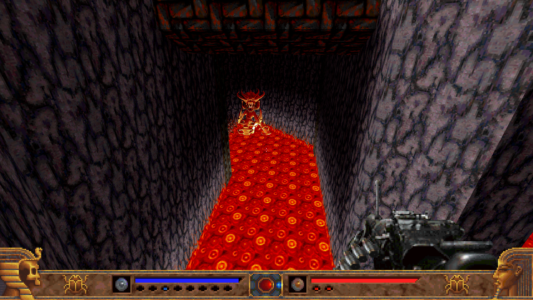
This bit I could have done without.
As I played I ruminated on what direction this review would take – I was expecting to conclude on “when I said it was good to stand out from the crowd more, I didn’t mean a run through Bowser’s castle”. As it turned out, this this section is briefer than I feared. For one thing, your last powerup is basically floating with infinite duration. This removes the a lot of the danger of plummeting into lava while also giving rise to a clever new challenge – you can float but not raise your height mid-air, so must find places to land on and make a new jump.
Also, the last couple of levels are amongst the best this game has to offer. Which, let’s be honest here, is not something we say about games very often. Yet here the devs seemed to use the best of their creativity. The aesthetic shifts to something more overtly alien while still keeping themes like pyramids and obelisks. At the same time there’s a good mix of action against a new, slightly tougher alien type and dealing with hazards. That includes a truly nailbiting room where you float around navigating a painfully precise path between a couple of dozen exploding tripwires.
So I’ve made a few criticisms along the way. Also, since this is still basically a cousin of the Build-engine games maybe we could have done with a Duke-style wisecracking hero (“I’m gonna turn this tomb into a boom“). The best of this 95-97 post-doom era includes greats like Hexen and Blood and I’m not sure if this one is quite their equal. It’s certainly not far behind, though, and kudos to bringing Metroid-ish elements to first person gaming before Metroid did itself.
On top of that, Night Dive have handled the remastering process adeptly as usual, letting you feel like you’re returning the 90s while actually enjoying some modern comforts along the way. If you want to return to the original 800×600 experience then of course, that’s still available also. So then, we’re happy to give this one a solid recommendation.
 Posts