
Gods
Written by: Stoo
Date posted: September 18, 2026
- Genre: Action
- Developed by: The Bitmap Brothers
- Published by: Renegade Software
- Year released: 1991
- Our score: 5
In the early 90s the idea of a “rockstar developer” was taking form – studios were the names and creative identities of the developers were as well known as the games themselves. One of the first – a few years before the iD guys showed up with their longhair and fragging and deathmatch – was the Bitmap brothers. They cultivated public personas for themselves, posing for photoshoots in sunglasses as if they were in a band. At the same time, their games were instantly recognisable thanks to their bold, metallic, carved aesthetics. Thus they earned celebrity status for themselves in gaming culture, and a loyal following.
They wrote primarily for the 16 bit home computer market that was thriving in the UK at the time – which is why they are mostly fondly remembered today by middle-aged Amiga fans. However, some of their games made it to the nerdier world of beige PCS and MS- DOS. Rik has reviewed couple in the past, looking at the brutal sports action of Speedball 2 and the frantic steampunk top-down shooter Chaos Engine.
Today’s item, Gods, starts with possibly the greatest intro music of the era. It was written by a big-name artist, and they had previous form in this regard – Xenon 2 famously featured Megablast by Bomb the Bass. This time we get Into the Wonderful, from John Foxx (formerly of Ultravox). I’m bad at describing music so, forgive me, I asked Copilot which told me “electronic rock with breakbeat and synth‑pop influences — a hybrid early‑90s UK electronic style”.
Whatever, it sounded amazing coming out of a computer in 1991, accompanied by a comic-book style image of a chiselled-looking Graeco-Roman warrior. Thus the intro projects exactly the sort of style and attitude you’d expect from a top-tier Amiga game from the UK.
Yet here’s the great thing – we PC nerds got to experience it too. It’s tracker music – that is, built of out of digital samples, which would have required a Soundblaster card. They were fast growing in popularity in 1991 but not yet universal, so there was a real danger of being stuck with a spongey AdLib FM synthesis version. Don’t get me wrong, I have huge fondness for adlib music, but here it would have been a let-down. Even worse Xenon 2, a year earlier, saw Megablast reduced to a dreadful flurry of PC speaker bleeps and chirps.
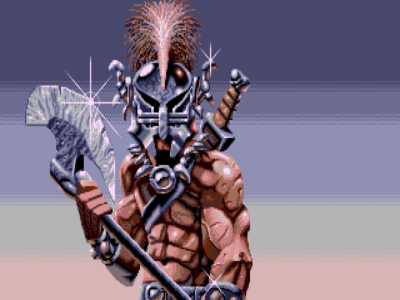
Chiselled-looking dude
This is meant to a be a site for discussing entire games tho, not just awesome intros of Amiga ports. So let’s move on. Gods is a platform game, casting you as the afore-mentioned chiselled-looking warrior dude. Delving into an ancient, abandoned city you will be fighting monsters by using various thrown weapons (spears, knives etc). You’ll also be solving puzzles and evading deadly hazards. By defeating four champions, it is your hope to win the favour of the gods resulting in… I’m not sure. Immortality, great riches, beautiful women, that sort of thing.
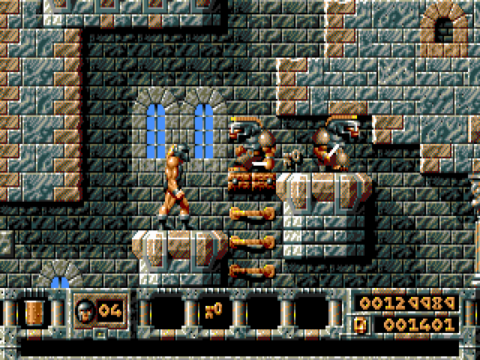
Our hero steps into the action with a steady and determined trudge, and his motion carries a sense of real weight. After all, he’s is wearing a load of bronze armour. When he jumps, there’s a pause for a brief animation of him bending his knees, gathering strength before flinging himself. Even turning around has its own small animation, because massive warriors don’t just instantly flick around 180 degrees.
So it’s not the fastest of games. Yet that hardly means its easy. Walking enemies don’t sit in the world waiting for you , but instead only spawn when you get close. Sometimes they will appear in front and behind simultaneously. Flyers drift in from offscreen and can pass through the scenery, meaning they may come at you from difficult angles. If you don’t have the best weapons, it can be difficult to kill something before it reaches you. Your health pool is small and drains quickly, and while health pickups can be found, Gods is not generous with them.
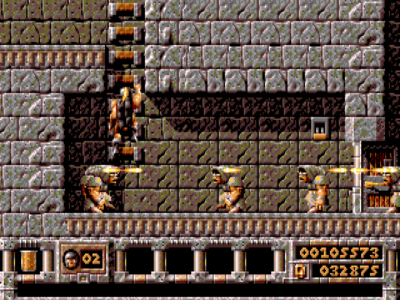
This could be a problem.
It’s complicated by all the things our hero can’t do, particularly regarding jumping. You cannot control the force of your jump, so little hops aren’t possible. You don’t have any ability to steer yourself mid-air either. You can’t even jump straight up. Every jump flings you in a fixed trajectory. You could argue of course argue that mid-air steering makes no damn sense when you think about it (unless your character has wings or whatever), but you still miss it when it’s not there, when a misjudged launch has sailing past a platform into a pit. By the way yes, there is falling damage.
I think I can see what Bitmap Brothers were aiming for here. A game where every motion takes a bit of time and effort, and thus you must be deliberate and methodical. You’re not flitting around the screen like a cartoon hedgehog, and it’s not primarily a test of reflexes. Rather, you should focus on positioning and timing, plan your route through a hazard and approach each new room cautiously.
That’s the idea anyway, but often the result is just awkward and clumsy. Knowing how difficult it is to respond to problems in time I’d usually just shuffle forward mashing the fire button like made, in the hope of hitting monsters the moment I’d spawn. Sometimes I’d be looking at enemies marching back and forth on a lower level thinking, I actually had no idea how to fight these without taking a load of damage. My lack of skills aside, it seemed a good solution didn’t even exist.
Forgive me, I’m going to grumble some more. The game was written for those one-button joysticks that were common on microcomputers, so the “up” direction has to double for both jumping and interacting with switches and doorways. So, yes, on several occasions that went badly and instead of ducking into a door to evade pursuing baddies, I’d go flying off a ledge.
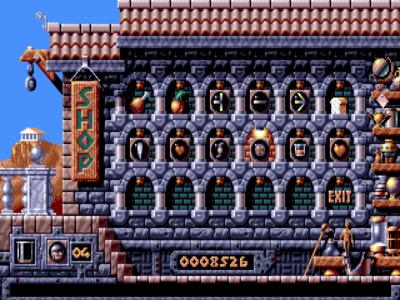
The puzzle-solving and adventuring aspect meanwhile sometimes involve finding the right combination of switches to open paths or deactivate hazards. Sometimes you’re told to gather items — chalices, keys, odd relics — and bring them together in a particular room. You don’t always need to solve everything to finish a level, but doing so often reveals a treasure room stuffed with gold and gems. And you want that treasure, because the shops that appear roughly once per level are your main chance to restock on health and buy weapon upgrades.
One genuinely clever feature is the “thief” type enemies that will grab a powerup or door key and walk off with it. There are occasions where an item you want is inaccessible, so the trick is to let the thief take it, then manipulate their movement so they end up somewhere you can kill them and reclaim the loot. It’s a neat little system — one of the few times the game’s slower, more methodical pacing actually works in its favour.
On a final note, we have plenty of that signature Bitmap Brothers artwork. Every stone surface feels carved and weighty, with sharp, sharp highlights and shadowed recesses. Repeated patterns and engravings add to the densely textured feel Monsters look like surly troglodytes, shoulder hunched as they march angrily towards you.
On the downside, well, every level is one of four variants of stone or metal walls with an palette of earth and bronze. So the art starts to feel drab despite its quality. Maybe a richly decorated palace or a gardens level , anything with a different mood could have helped. Also, while we’re discussing presentation, after that awesome intro there is absolutely zero in-game music. All you will hear is clinks of loot, grunts from our hero and weapon effects.
(We can at least say these aren’t porting issues – as far as I can tell this is close to identical with the Amiga version)
If you go to any retro-gaming Facebook group and search for posts about this game, you will see an outpouring of love from those middle-aged Amiga fans. Speaking for myself (middle-aged DOS fan), well, I’m not here to be an edgy naysayer; on this site we will never slate something popular just to try and hold ourselves up as clear-sighted individuals amidst a sea of blind nostalgia. Still, once the intro was past I could summon only moderate excitement for this one.
It gets some things right for sure, an undeniably stylish work bringing a bit of Amiga attitude to our beige dorky PCs. I also I always appreciate games that encourage you to explore a level thoroughly and deduce how their systems fit together. Yet much of its difficulty feels artificial, the sort of thing you could fix without turning the whole thing trivial. I should be able to jump straight up to shoot something! I freely confess I played this using save states, and without them I’d probably be somewhere on the fourth level, swearing at some monster that suddenly spawned behind me.
Honestly, I’d rate several PC‑native shareware platform games — with their EGA art, dorky vibes and AdLib music — as at least equally positive experiences overall, and sometimes superior. So look, if you have fond memories of this one, if you associate the Bitmap Brothers with happy times 35 years ago, that’s great. There’s always a degree of subjectivity here and I freely admit to being impatient and easily frustrated. Honestly though, I’d rather be playing Commander Keen.
One final note – I encountered issues in one place the game crashing at a specific location, and couldn’t find a way past without a level-skip cheat. I’ve not read about anyone else having the same issues so it could just be an issue with Dosbox-daum)

 Posts
Posts
I’ve been trying to figure out if we got enough of the UK Amiga experience here in the states through the Sega Genesis. Similar ballpark specs and such. But there’s a style of “chunky Amiga platformer” that, I think, stayed exclusive to the system.
I look at Batman the Movie, and yep, Batman Returns on the Genesis or Sega CD seems to cover it just fine.
I look at this game, or Total Recall, and nope. There’s that chunky style that I don’t think really made it over here. Maybe your “weighty” is the better descriptor.
Then the question would be if we missed out.
September 21, 2026 @ 9:52 pm
Right, I’m not clear as to how popular the Amiga was over there? Here it was a natural successor to the 8-bit micros, until the PC took over.
Incidentally Gods did get a SNES port, although it doesn’t seem great. Lower-res so a smaller area is drawn around you, and also faster. I imagine both these changes make it harder.
September 22, 2026 @ 9:02 am
I might look at SNES Gods then. I knew about the many Amiga ports to Genesis (same CPU) but SNES would be closer in colors. Wonder how many Amiga games got converted for SNES.
8 and 16 bit micros were basically just a hobbyist thing here. Radio Shack had their cheaper Tandy line, you could buy a C64 or spend a ton on an Apple, but I never knew anyone who did. Atari was huge in the early 80s, then seemed like everyone had an NES late 80s. NES was by far the dominant games platform. Renting cartridges at the video store was our closest analog to copying and trading cassette tapes.
We never had a BBC Micro or similar. Closest was Apple selling II and II/e, then Macs, to schools at a discount. But not as any kind of beneficial program for the youth; more as locking down a steady and guaranteed customer for Apple. Most schools had 30-40 in a computer lab. Then those IIs would move into individual classrooms as the lab upgraded. But a computer was not something you’d ever have at home. It would be like taking a bunsen burner home – you could do everything you need to with it in the classroom.
We got our first computer, a Compaq 486, in 91 or 92. Prior to that, we had an electric typewriter. My friend had a word processor, which was a weird novelty. Somehow we saw using it as more cumbersome than White-Out and highlighters. Computers just weren’t seen as necessary – I wouldn’t even say a luxury, just flatly not necessary. I’m sure my Dad had a 386 at work, but no expectation yet to take files home to work on. We had the Apples in school. Had the NES for games.
I’m sure it’s different if you had a job in computers, and I don’t know if I’m the most common example. But even Ferris Bueller’s simple setup was like “ok, weird Hollywood kid.”
September 22, 2026 @ 2:30 pm
Interesting how histories differ. Here the 8-bits enjoyed widespread popularity from the early 80 onwards. NES was poorly marketed and distributed, games were expensive and there was no “crash” leaving a big gap in the market for it. Sega, I think, did better. SNES was more successful than NES, although it was outsold by the Megadrive.
Funnily enough I have no personal experience of any of this – at home we had an Amstrad 1512, the first (relatively) affordable IBM-comptaible PC. It was… not great for gaming.
September 25, 2026 @ 3:58 pm