[ Content | Sidebar ]

Thanksgiving retro-gaming

December 1st, 2016

Written by: Stoo

I’ve just returned from a couple of weeks in America visiting the Wife’s family and celebrating thanksgiving. Which was pretty great, with the key traditional features of a family gathering and stacks of food. Even if due to a hectic schedule led to us chopping vegetables and making pies at 2am the night before.

Anyways my brother in law has lately been in the mood to revisit some old Nintendo favourites, so while over there I was introducing him to emulation on his PC. As it happens I learned a few new tricks myself, because instead of installing a bunch separate emulators we ended up setting up Retroarch, something I’ve not tried before.

If you haven’t heard of it, Retroarch is a front end for running emulators for many different systems. The emulators are referred to as cores, and there are a wide range available, for just about every console you’d want. For popular systems like the SNES you’ll have a few choices. The cores are created by third parties and I think many are based on standalone emulators (I recongised Nestopia in there for example).

Cores aren’t included with the base package, but adding them is dead easy as you can choose what you want to install from within the Retroarch interface. Roms however, you will have to provide yourself from external sources, of course. I recommend emuparadise.me. Then just go back into Retroarch and tell it to scan whatever directory you put the Roms in.

The gui is geared towards use on a big screen, so it’s fairly uncluttered. It’s also geared towards use with a gamepad. In fact we found xbox controllers worked great for both the gui and cores without much tweaking required.

So we were pretty quickly up and running playing Mario Kart. My brother in law wanted to revisit Chip And Dale’s rescue rangers, which I’d never played but recognised as the work of Capcom, something about the music and graphics was a bit megaman-ish. He also indulged me in a game of Final Fight 3, one of my favourite of the old scrolling Beat ’em Ups. In which I always play Mayor Haggar because he can grab bad guys, jump into the air then piledrive them into the sidewalk.

One other matter to report: we were also taken to an amazing arcade full of old 80s and 90s games. You pay a flat fee up front, at the door, then play any games as much as you like. Which is great because I suck at these arcade classics, so infinite continues are a must. I had a blast on a bunch of games including Galaga, some truly ancient vector-based star wars game, and Gauntlet 2. Meanwhile my wife and sister in law were happy playing some old racing game, and some pinball too.

The highlight was the 1992 x-men beat-em-up, which all four of us could play together. Infinite lives meant we could freely use the health-draining special moves, so I spent the entire game spamming Colossus’ “angry explosion” attack. Which he never actually does in the comics because his powers have nothing to do with explosions. We also had a four-player go at the Turtles arcade game, a trip back to that first wave of cartoon-fueled turtles mass popularity, circa 1989. This was entertaining also, although I was occasionally trying to control entirely the wrong turtle, since they all look pretty similar to each other.

So if you ever happen to be around northern Illinois, pay a visit to Underground Retrocade in West Dundee.

Real cars, real racing

November 14th, 2016

Written by: Rik

Hi there.

How are things? Anything going on in the world? I’ve been on holiday, just catching up.

Today we’re looking at some semi-serious racing action, in the form of RACE: The WTCC Game from Simbin.

racetitle

Hail to the king, baby!

October 20th, 2016

Written by: Stoo

This year marks the 20th anniversary of Duke Nukem 3D. To commemorate this, 3D Realms have released World Tour Edition on steam, featuring a new fourth [edit – make that fifth] chapter created by a couple of the original level designers.

When I wrote about my favourite early shooters, I sadly chose to omit Duke3D, mostly because I never actually played more than the first (shareware) chapter. I’m more familiar with Blood, which used the same engine, so that took a slot on the list instead. Still, it made a strong impression for a couple of reasons.

Most obvious is the game’s general attitude – the machismo, the goofy humour, the stacks of movie references. Duke is an iconic gaming protagonist, a pastiche of 80s action heroes with his shades, his swagger and the gravelly voice. The game is, I think, aware of how ridiculous he is yet it’s totally unashamed. He mows down pig cops, delivers one-liners, and goes to strip clubs.

Most of this I can still enjoy. Not so sure how I feel about the strip clubs. Maybe I can take that as all part of the joke too, but if lady gamers are put off, I will not blame you. The women in pods moaning at you to kill them, is definitely just unpleasant and jarring.

Moving away from that sort of Serious Business topic, this was the first shooter I played with maps that looked like something in the real world. I think there’s a more subtle point at work here too, it was a shooter with locations that looked like they had an actual purpose.

Consider Doom for a moment – you might be told a level was a toxin refinery or a command post, but it was mostly just an abstract collection of rooms and corridors with a scifi theme. You’d be hard pushed to say what was meant to happen here. Duke however gave us streets, a bar and a cinema. Nowadays urban drabness is actually overdone and kind of tedious, but in 1996 it was new and exciting. We weren’t in some vaguely defined fantasy or scifi fortress, these were the sort of places that actually existed in a city.

To enhance the realism, 3D Realms packed their maps with all sorts of details, many of which were interactive. Duke could smash bottles, knock pool balls around. The duke-themed pinball machines didn’t actually do anything, but they did provide a chance for another bad joke (don’t have time to play with myself!).

Duke arrived at a time when we were looking for a new king of the first person shooters, as Doom aged. It was a new and exciting challenger for that throne, but was unable to claim it for long. A few months later Quake showed up and wowed shooter fans with its next-generation, true-3D engine. Yet even if it was stuck in the 2-and-a-half dimensional shenanigans of earlier days, I always preferred Duke3d personally. Quake was advanced but drab and uninspired, a game of grimly shooting grey monsters in brown castles. Duke3D had some colour, personality, and attention to detail.

The World Tour edition will set you back £15 on steam. Which is more than we normally pay for a 90s shooter (Quake is £4) so I guess you’re paying for that new chapter. The original full version of the game has been pulled from digital distribution, but, if you just want a few levels of Duke without shelling out, the shareware version can still be downloaded from 3D Realms. (you will need to set it up yourself in Dosbox).

CSI: Deadly Intent – The Hidden Cases (Extras!)

October 15th, 2016

Written by: Rik

Hello! So, I captured quite a few screenshots, bits of audio and video clips for my piece on CSI: Deadly Intent – The Hidden Cases. Although I was able to use most of what I wanted to in the main article, I figured I may as well stick some of the rest up here.

CSI: Deadly Intent – The Hidden Cases (Extras!) continued »

CSI: Deadly Intent – The Hidden Cases

October 15th, 2016

Written by: Rik

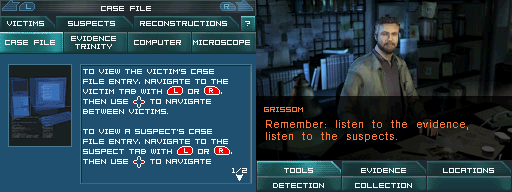
This is a review of a Nintendo DS game. We don’t review DS games on here, except here we sort of are doing that, obviously. But it’s not going in the main list of PC reviews. As discussed previously, I sort of just wanted to write about this game and get it out of my system.

The first CSI game to be released on the Nintendo DS was a port of 369 Interactive’s Dark Motives. To be honest, it wasn’t great: the source material was pretty bad to begin with, so a technically-compromised version of an already rather stiff and uninspiring adventure was never likely to be a success. There was potential in the format: the DS interface made for easy adventuring on the go, the touchscreen and stylus a ready replacement for the desktop PC’s mouse pointer, but it needed, you know, a little more thought than simply trying to cram an existing CD-based game onto a tiny cartridge.

DS Dark Motives: the presentation gives the written dialogue a certain “Jill Sandwich” quality.

A better approach, then, was to develop games specifically for the system: while many PSP games fell into the (admittedly tempting) trap of almost-but-not-quite recreating the PS2 experience on handheld, the DS wasn’t powerful enough for developers to have to confront that dilemma on a regular basis. Games that focused on what the machine could do best, both from an audio-visual perspective and in the use of the touchscreen, had the best chance of being successful.

CSI: Deadly Intent – The Hidden Cases is a great example of this. Not only is it an improvement on the DS version of Dark Motives, it’s better than the PC version of Dark Motives or any of the other CSI games. It’s also – wait for it – the best looking and best sounding of all the CSI games, which is some achievement given the limited technical resources of the system on which it was released.

CSI: Deadly Intent – The Hidden Cases continued »

The Shelves of Shame

October 2nd, 2016

Written by: Rik

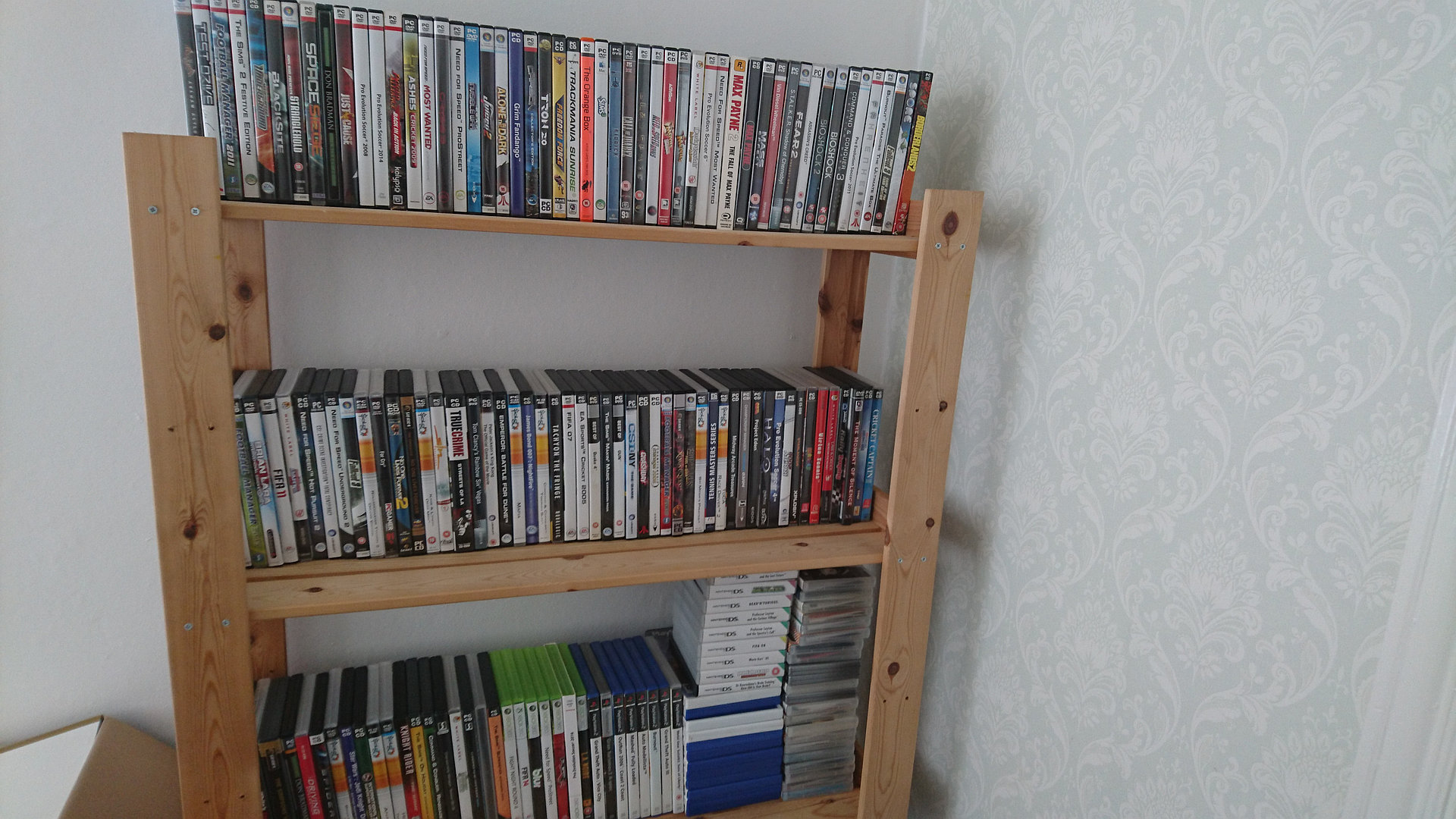
The Cupboard of Shame is no more. No, I haven’t purged my collection of regretful purchases, or accepted that perhaps I’m not ever going to play that strategy game, especially not if I need to dust off my old XP machine in order to play it. But the Cupboard of Shame, once a metaphor, was most recently an actual cupboard, aptly titled not just because it housed sealed budget copies of Commandos titles, but also because it became a dumping ground for any other computer related crap, wires and old phone chargers. (And there was a mouse in there once, its discovery prompted by evidence that an instruction manual for an old copy of SingStar lurking in its depths had been subject to some enthusiastic nibbling).

I suppose I’d also never really got over that teenage feeling that games were a bit shameful and not to be proudly displayed with your films and books downstairs, and instead belonged out of sight in a spare room (with your Linkin Park CDs). These days, though, showing off your gaming collection is more of a ‘thing’, especially among enterprising YouTubers who make use of their seemingly abundant free space to proudly show off the fact that they never got rid of their big box copy of Theme Park, and so, armed with a spare free standing shelving unit, I set about putting my own games out in the open (still in a spare room, but a different spare room from the Linkin Park CDs).

shelvesofshame

The Shelves of Shame continued »

Adventurer’s Guide to Guardia, part 2

September 21st, 2016

Written by: Stoo

Hi all. Rik’s lately been moving house and my wife has immigrated to join me in England’s Green and Pleasant land, so we’re both a bit too busy for much gaming lately. However, I still have many wasted years of my youth to draw on for inspiration. So here’s the second installment of my guide to Guardia, the world of Wizardry 7.

Munkharama
The holy city of the Munk, a race of short red, robed guys who are big fans of alchemy and kung-fu. Features a picturesque (well, as close as the graphics can manage) lake and the infamously horrible spindle puzzle (just swim around the damn thing).

Also the Palace of the Gran Melange, a rather trippy section in Guardia’s version of an opium den. Intoxicated Munks ramble about whether or not dreams are reality, or something. Then you fight ghosts and witches, smoke something dubious, fall into an abyss, and meet a Sphinx which pontificates at great length about what defines a human being. Basically the game is taking some time here to indulge itself in philosophical musings. The walls of text are all worth it though as you end up with the mighty Sword of Four Winds.

This city’s main dungeon sectio ,meanwhile contains the bastard-hard Lord of the Dark Forest, but also an item you need to get your boat working.

Rattkin Ruins
The Rattkin are rodent people, as you might have guessed but they are also modelled on contemporary criminal organisations (Wiz 8 gave them New York mobster voices). So their elite warriors are called Razuka and their leader is addressed as Don. Their city is kind of a long walk to reach, and a pain to navigate, but it does have the game’s only dedicated archery shop.

A large portion of your time here is spent in “Rubi’s Funhouse”, some sort of abandoned and dilapidated amusement attraction. It’s a bit incongruous in this sort of fantasy setting. I can’t picture any of the peoples of Guardia building such a place.  However, it should be pretty obvious that it’s going to be full of danger and murder. When fighting the Rattkin, that generally means getting showered with arrows and stones whilst their most poweful fighters slash away with poisoned swords. Also, just to make sure you’re stuck here for many hours, there are a bunch of slightly tedious puzzles based around activating various mechanisms. These are made all the more frustrating when you’re trying to find a switch to divert a water slide, or some item to trigger a pressure plate, and you keep getting interrupted by goddamn random attacks.

Witch Mountains\Giant Caves
This extensive region of caves and wildnernesses is based around mountains, which the game’s engine can’t draw any more than it can a tower. It doesn’t even have the capacity for backdrops. So you just have a bunch of discrete regions of rock and forest for progressively higher reaches of the mountainside. Text descriptions fill in the gaps once again, aling with your imagination. Despite these limitations, the witch mountains do manage to feel a bit remote and exciting, a long way from the (relative) safety of New City. You won’t see much of the civillisations of Guardia here, but there are plenty of monsters :giant fire-breathing crows, massive lizards and two-headed lions.

Somewhere around here there’s a cave populated by Giants, then an actual dinosaur that makes for quite an epic fight. There’s also a bit of a puzzler in another cave about finding out the names of a bunch of witches. Hint – you need to find a field in this region where some weird events occur, and something to help you better see what’s happening there.

Isle of Crypts
This little island in the middle of the ocean contains the entrance to a sprawling complex of catacombs that comprises the endgame.

Near the surface is a series of dungeons full of traps and dragons. Remember your fire shield, and also some random junk you picked up in Orkogre months ago. This is the easy bit, though. Further down you find yourself facing a labyrinth full of teleporters, that quickly leave you extremely disoriented. The trick is to realise each teleporter is just moving you vertically to another floor. Make careful maps on paper of exactly where each one takes you.

In the lowest reaches the game loses all restraint on its scifi-side and starts throwing giant goddamn robots at you. Once you reach this level you’re close to a final showdown with the Dark Savant himself.

Except he’s not actually the toughest foe down here. About midway through the dungeons you’ll find the Chamber of Gorrors, containing a bunch of unique, extremely powerful monsters. If you wade in unprepared you’ll get stomped flat, shredded and incinerated in about half a turn. However fights are totally optional, a challenge for players with high-level parties and a good understanding of how to best use their characters spells and abilities. Kind of like the Weapon fights in Final Fantasy 7.


An Adventurer’s Guide to Guardia

September 12th, 2016

Written by: Stoo

I’ve written before about some of the monsters in Wizardry: Crusaders of the Dark Savant. Today I’m providing a handy guide to the planet of Guardia, on which Crusaders takes place. This is the fantasy world in which I spent far too much of my time in my mid-teens.

I’m not going to give screenshots for each location because A: I don’t have them and B: the game is pretty samey-looking anyway, being based on very square designs and made entirely out of just four different tile-sets. Features like furniture aren’t even drawn on screen. The world is brought to life through the characters you meet, the monsters you fight, and the narrative text which provides evocative descriptions and occasional philosophical musings. You also have to use your imagination a lot, to embellish the spartan graphics into your own mental picture of the world around you.

Here’s a city!

Single-storey yellow stone buildings are very popular on Guardia.

Here’s some forest!

A Phoot in the Forest. Bash it!


Okay, that’s what half of what the game looks like. Let’s continue!

New City
This is the first city you reach, and serves as a hub for adventures and exploration of the wider world. It’s stocked with several shops and services for your party, as well as many NPCs to encounter. This is all quite normal for cRPGs.

However because this is Wizardry, it’s also full of monsters and bad guys who will try to murder you every 12 paces. Random encounters happen in cities just as much as in wildernesses or dungeons. I don’t just mean the bad end of town. every step you take, and every attempt to sleep, has a chance of spawning an attack in any location. This includes the peaceful abbey, a room in the tavern and the shed where the old sailor guy is trying to build a boat.

The eerie android servants of the Dark Savant are supposed to be keeping this place on lockdown, but they’re clearly doing a lousy job. Fortunately once your party reaches level 10 or so, you’re strong enough to overpower most enemies here quite easily.

Ukypr
We never learn who originally built the jungle city of Ukpyr. It’s currently occupied by the Umpani, a spacefaring race of Rhino-like people who have come to Guardia searching for the Astral Dominae. If you come here you can join their army as a kind of auxiliary scout. You can carry out a few missions for them, earn some hold, and learn how to use firearms.

The Umpani seem like a fairly benevolent bunch especially compared to their main rivals, the spiderlike T’Rang and the Dark Savant himself. They welcome you into their base, as long as you don’t go into restricted areas. Random battles with Umpani are rare, and usually involve their criminal element.

Ukpyr still has its dangers though. You will often encounter angry undead spirits, swirling out of thin air and howling at you as they attack. You’d expect this if wondering some spooky crypt, but not a military barracks. No explanation is provided as to why the restless dead are roaming the city, which just makes the situation a bit more weird and creepy. What exactly happened here? Some sort of massacre? Are the Umpani responsible or were the ghosts already present when they moved in?

Dionysceus
The mighty tower of the Dane, a race of powerful wizards. Well, it’s a tower according to the text. Crusaders’ graphics are basically intended for building dungeons. Tiles representing sections of floor, wall and ceiling are arranged to fake a 3D view of the world. It’s the same sort of system as used in Eye of the Beholder or Dungeon Master.

These graphics can handle forests and cities of single-storey buildings also; you just take off the ceiling. Anything with a vertical component is impossible, however. Everything stops about ten feet above the ground. So when the narration states that you’re seeing a tower in the distance, you have to just go along with it. A short while later you encounter an abstract singles-story stone structure and that, apparently, is the tower’s base.

Fortunately the interior is made of separate maps anyway. Once inside you can ascend through the levels of the tower, each posing increasingly difficult challenges, sometimes with an element of puzzle solving. There’s a room entirely in inky blackness. On another level pits in the floor block yourr way, and stepping on each floor tile opens and closes pits, so you must figure out what sequences of movements gives a clear route out. Another level, kind of similar, has doorways disappearing into smooth walls, and opening again, depending on where you tread.

A Dane overseer presents all of this as a series of trails you must pass in order to join the ranks of their mystic order. He also extorts money out of you every step of the way. I’d say screw that guy, but you probably will end up killing his leader and emptying the tower of loot anyway.

Orkogre castle
Here’s the easier way to fake a massive structure like a castle; put it all underground. All you see of mighty Orkogre, before you enter, is a ladder sticking out of the ground.

Your first major expedition after New City will probably be here. You’ll test your strength against Gorn lancers and rangers, possibly get slaughtered by the elite Ashigaru, and hopefully gain some new weapons and armour to upgrade your crummy starting gear.

Then you reach King Ulgar, for whom you have an important message. Before you can deliver it to him, though, Ulgar launches into a protracted monologue about civil war, treachery and his fractured kingdom. This goes on for several minutes, while you wait patiently. I guess he has a lot on his mind, and no-one else to talk to. Although he will then promptly attack you if you don’t give him the correct message.

Meanwhile in a lower level lurks the Shadow Guardian. I hate you, Shadow Guardian. If we all have our gaming Nemesis, that undead monster was mine. The abominable thing just toys with you for several turns, then casually wipes you out with an Asphyxiate spell.

City of Skies
Home of the Helazoid, buxom young women on rocket bikes. They’re basically a race made up entirely of scifi pinup girls. Hardly the worst example of sexism in gaming, but still a bit ridiculous.

Anyway for some bizarre reason, their city is filled with invisible walls. These don’t even show up on the in-game map. So your only option is to get properly old-school here; break out your squared paper and make your own maps. No justification within the game is made for this frustrating civic feature. I suppose it could be intended to thwart invaders, but, to even reach this damn city you have to kill a colossal sea monster, then fight your way through dragon-infested caves. I think they would already be a pretty difficult target.

It’s worth coming to the City of Skies anyway, and diligently making your map, since you can get one of the most powerful swords in the game here. Which is basically a light sabre.

You can go sleep at home tonight if you can get up and walk away

September 4th, 2016

Written by: Rik

Hi there.

Sorry for the radio silence: I always find August to be pretty unproductive, but this time I did have a genuine (but boring) excuse – moving house.

Anyway, time to get back on the reviewing horse with a look at CSI: Deadly Intent.

csidititle

Nes Mini, and other ways I could finally complete Zelda 2

July 26th, 2016

Written by: Stoo

Our main focus on this humble site will always be old PC Games, but we do have an interest in other forms of retro-gaming. I’m in the sort of odd position of being a fan of the NES and SNES, despite never owning either as a child (it was a PC-only household). Instead I just played on friends’ Nintendos whenever I could. Then around the tail end of the 90s, I discovered the wonderful world of emulation (you may remember Nesticle), and played through classics like castlevania and megaman 2 aided by vast amounts of save-scumming. A few years back I picked up a Wii, partly because of the appeal of the Virtual console, although that remains sadly under-used.

So I’ve been pondering the merits of the recently announced Nes Mini. It looks like a smaller version of the classic NES, has the old-fashioned square controllers, and comes with 30 games installed. It’s a very convenient means of revisiting some classic games, just plug into a TV and off you go. It’s also a legitimate nintendo product that avoids the legally dubious world of emulation and Roms (if you care about that). On the other hand, though, there’s no way to add more games to it. I was hoping for some sort of online store but, nope, those 30 titles is all it will ever play.

There is some instant nostalgic appeal to the thing but, thinking longer term I’m not sure I’d want to spend £50 on a device that locks me into a fixed selection of games for one system. I’d rather have either the true 80s authenticity of an actual NES, or the flexibility of some sort of emulation-based device.

For an example of the latter, I’ve experimented with setting up Retropie on a raspberry pi. This package consists of a bunch of emulators joined by a common interface, letting you play games for a whole host of different consoles and old computers. It’s not a good option for totally non-techy types who just want a plug-and-play device, as there is a fair bit of pratting around with configuration files and command prompts. However if you don’t mind all the tinkering involved, it provides a huge wealth of retro gaming options all packed into a box about the size of two packs of cards.

Alternatively, you could consider the the JXD 7800B, an android tablet with physical controls, plus hdmi output The range of emulators available on Android is pretty good, you’ve got your obvious choices like the NES but I’ve found the Atari ST and Lynx on there too. Of course any droid can run them, but, most are stuck with terrible touchscreen controls.

Then there is the Retron 5, which takes original cartridges for NES, SNES, their Japanese equivalents, Megadrive, Gameboy and GBA. Good for those of you who want to play old carts for all those systems but don’t have room for multiple consoles under the TV.

That’s just a few ideas. There are other emulation platforms out there, and also a range of NES clones that can take cartridges. Honestly though, I may just continue to play old console games the same way I have done for about 16 years now; emulators on a windows PC. I’m a creature of habit.