[ Content | Sidebar ]

Now you’re playing with Super power

October 24th, 2017

Written by: Stoo

Well, I got that SNES classic. In fact I found one to buy the same day I started looking. Which was a pleasant surprise after the ridiculous difficulties in obtaining the NES classic. I may have gotten lucky, or maybe Nintendo had the sense to ship more units this time.

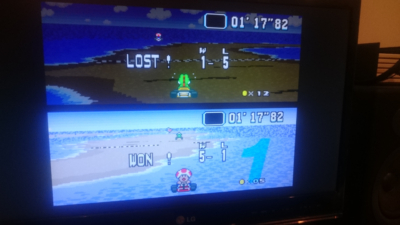
First thing the Wife and I played was Super Mario Kart. Here’s the outcome of a typical race, with me on the upper view as Yoshi:

It’s difficult to come up with a decent review for this one, without merely rewriting the article I did for its predecessor. Same sort of device, same limitations, same appeal.

I suppose I should start with a reminder of what you’re actually getting for your money: a little emulation box, shaped like the original console (Euro\Japanese version or US as appropriate), with 21 games pre-installed but no official way to add more. It comes with two controllers, needs a USB power supply (not included, but you do get a microUSB cable), plugs into your TV via hdmi (cable included).

Setup options are minimal, but you do again get three choices for graphics. Pixel Perfect gives a square output, and I think is the accurate display of exactly what the SNES outputs. 4:3 mode stretches the graphics into the aspect ration more typical of TVs of the day, making it all just a little fuzzier in the process. Finally the CRT filter mimics the effect of displaying on an old TV, complete with scanlines. I still prefer the first option, probably because I got used to playing NES and SNES games via emulators on PC.

It has most of the first-party classics we would demand – Super Mario World, Zelda 3 and so on. There are some 3rd party greats too – like Final Fantasy 6 and Streetfighter 2 Turbo. Then as a special treat there’s Starfox 2, never before released. There are several major games who’s absence is felt; we lack Chrono Trigger or Super Star Wars. Would have been good to include Mario Allstars too. Still there’s a solid collection here covering some of the systtem’s best games in several genres.

It’s a comprehensive reminder of just how great a console the SNES was. Sure, I’m meant to be proclaiming the superiority of the PC on this site, and as we moved into the 90s our beige boxes were starting to emerge as decent gaming machines that could hold their own against consoles. Still, the SNES had some all-time classics, and it remained superior to the PC for certain kinds of games. As much as I like Commander Keen, he wasn’t equal to Super Mario world. We never got the sublime Link to the Past, or the truly epic FF6.

Total number of games which is less than the NES Classic’s 30. Then again, some of those NES games were early, primitive stuff. After about 10 minutes of excite bike I’d had enough. The SNES games are generally more sophisticated and substantial, so you probably get more hours total entertainment. (unless you really like Excite Bike, anyway).

Once again, I could make a more versatile and capable device out of a raspberry Pi. I may yet do exactly that, now we have a new house and I actually have some room for such technical pursuits. Right now, though, I’m not in the mood for spending an evening installing operating systems, tinkering with settings, and then getting cranky when it fails to recognise a controller.

What’s more, even if this thing is itself an emulator, it’s still a more authentic piece of Nintendo charm. It’s a product directly from those people who delighted us as children, a modern tribute to their classic consoles. So I plug in this little box, happy music comes out and within minutes I’m getting lapped on the Donut Plains.

If I have a complaint, it’s that the RRP is £80. The NES classic cost £50, and the Pi goes for about £32 (plus whatever accessories you need). It’s approaching the limit of what I’d call appropriate for a casual nostalgia-box. Although I guess £10 of that can be put down to the second controller, something missing from the NES classic.

That aside, if you loved the SNES, you may well love this too.

No-one can move, move, move, like the Red Tribe do

October 22nd, 2017

Written by: Rik

Hello.

It’s a return to retro football action with today’s review, of Manchester United: The Double.

Warning: contains the embittered ramblings of a Leeds United fan.

Hot action cop

October 7th, 2017

Written by: Rik

Hi there.

Today’s review is of Need for Speed: Hot Pursuit 2.

Featuring the origins of the phrase ‘road trousers’, and for some reason a world record number of links to other reviews of racing games on the site.

See you next time!

25 years of Championship Manager (and Football Manager)

October 1st, 2017

Written by: Rik

It’s been 25 years since the original Championship Manager came out. I didn’t remember this myself, of course, it was in The Guardian, along with this collection of stories from fans of the series. Despite never quite hitting the mad 20-season, multiple-Champions-League-winning heights of many hardcore players, I’ve certainly fallen victim to its time-sucking charms on numerous occasions over the years, so here are some memories of my own.


25 years of Championship Manager (and Football Manager) continued »

I hate you, Class 1 Drillers

September 29th, 2017

Written by: Stoo

Before we get into my nonsense, this week have some proper content from Rik, a review of The Elder Scrolls IV: Oblivion! So go read that first.

Anyways in this occasional series I complain about getting my ass handed to me by the monsters and enemies in various games. Today’s entry is Descent, created by Parallax Software in 1995.

Some gamers class this one as a space-sim. It’s true that you pilot a little spacecraft, but I always thought it was better described as a first-person shooter. Or doom-clone, as we called them back then. The controls and combat are much more like a shooter than a sim, except there’s no gravity and you have a full six degrees of motion (move in three directions, rotate around three axes).

The freedom of movement was a key attribute that helped Descent stand out from other doom-clones, but also meant the game could become rather disorienting. It was tricky to keep your bearings as you spun, pivoted and traversed to keep the enemy in your sights. Distinctions between walls, ceilings and floors often disappeared and it was common to be a bit confused as to how to get out of a chamber you only flew into 30 seconds ago.

The game is set in a series of mines across the solar system. In each one you must fight past hordes of robots, destroy a reactor and make a hasty exit. The game provided me with many hours intense action, hurtling through claustrophobic tunnels and circle-strafing robots in huge caverns. Also, dying a lot.

Class 1 Driller
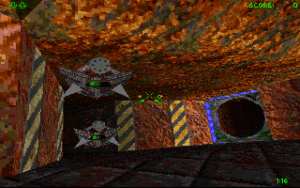
Image from mobygames.

Let’s talk about the Vulcan minigun for a second. It’s the game’s one and only hitscan weapon. That means, there’s zero time between firing and impact of the bullet on a surface or enemy. Every other weapon fires some sort of blob or energy pulse that takes some amount of time to travel. That may just be a second or two, but hitscan still gives an advantage since you don’t have to lead a moving target in your crosshairs. In other words you can fire where the target is right now, not try and aim for where it will be in a moment’s time.

So the vulcan is an important part of your arsenal. Unfortunately, these little bastards have it too. It doesn’t help that being kind of small and grey, they can be hard to spot at a distance. Your first warning they are around will probably be be that characteristic shriek that means they’ve seen you and are about to open fire. Dive for cover immediately.


Medium Lifter
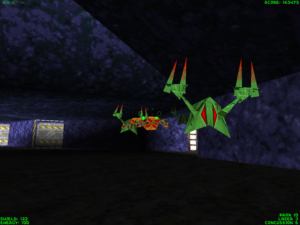
You’re making your way along some tunnel, thinking all is clear, when suddenly these horrendous things appear from a side passage and start chopping at you with huge metal claws. Oh and they screech at you like the drillers. The best way to handle the lifters is to calmly put some distance between you and them. The entirely wrong and much more common way is to
1: panic
2: emit a pitiful crying noise
3: lose all mastery of the controls
4: bump uselessly into the nearest wall and fire in random directions until dead.


Heavy Hulk
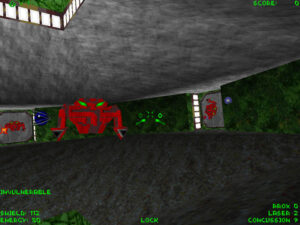
These ponderous, blocky machines don’t move much; they generally don’t need to. Instead, they continuously launch homing missiles. Fighting the hulks is a matter of sliding in and out of cover, squeezing off brief bursts of fire then immediately hiding again before another missile smashes into you.


The big F&*!er
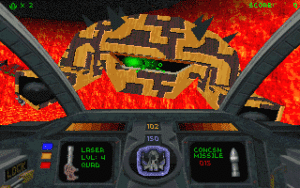
Mobygames again.

This enormous monstrosity is the boss found on level 7 (the end of the shareware portion of Descent). It has a similar profile to other missile-firing hulks but dwarfs them in size, and it gives off an unsettling rumbling noise.

It fires smart missiles, a variant on the homing theme. The missile itself doesn’t steer towards you, but on impact it launches a bunch of bright green energy bolts in your direction. If these hit you, you’re toast. While you’re avoiding these the boss can both cloak and teleport. So by the time you’re ready to return fire, its behind you and launching another missile.

I don’t know if it has any sort of official name other than “first boss”. My first encounter with it began with loading a savegame on a friend’s PC, that he had titled “the big fucker”. I think that’s quite appropriate.


Blowing the Reactor
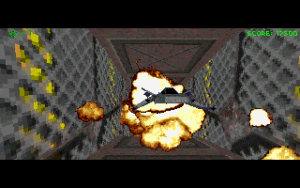
This one too.

Okay this isn’t a specific enemy, so much a scenario that occurs at the end of most levels. Upon destroying the reactor a countdown begins. You have somewhere between 30 and 60 seconds to find the exit, before the entire place blows up.

You did study the map beforehand, right, so you know where to go? Even then the game is liable to lock doors, forcing you to find a new route. More enemies may also appear, blocking your path. Not to mention the entire place is shaking around you, adding to the sense of urgency.

It’s all pretty intense, setting the heart racing as you hurtle down tunnels. You don’t even really try to fight enemies properly, just haphazardly spray them with fire while trying to dodge around. The situation can easily descend into sheer panic if you take the wrong path, as the seconds tick down.

So the escape runs are something I came to both dread, and also appreciate as one of the signature features of the game.


Through faith, your afflictions are banished

September 24th, 2017

Written by: Rik

Hi there.

It’s been a bit quiet on the reviews front recently, but I’ve been quietly chugging my way through this one for a while.

Some 10 years after Stoo speculated that I might one day play an Elder Scrolls game, we have a look at The Elder Scrolls IV: Oblivion.

all available hands to the guns!

August 31st, 2017

Written by: Stoo

Homeworld and its sequel have been available on gog and steam for a couple of years now. Both games have been remastered and put together in a bundle that also includes their original versions.

Today I found myself idly wondering if Cataclysm was also available in some form. Turns out it appeared on gog back in June, under the new name Emergence. The “Cataclysm” trademark now belongs to Blizzard, who used it for a Warcraft expansion back in 2010.

I’m glad to see Cataclysm isn’t forgotten, since I always thought it was just as great a game as the original. It uses the same engine and is very similar in many regards; it was regarded as more a standalone expansion than a true sequel. That’s why the next Homeworld, not this one, got a “2” in the title.

However Cataclysm very much establishes its own identity, with its core theme of a rag-tag fleet put together by miners. Unlike the efficient professional military of the main games in the series, here you command a motley collection of converted industrial ships, purchased technology and improvised weapons.

So you get kamikaze fighters that disguise themselves as enemy ships, and insidious little drones that clamp onto enemy vessels and chew through the hull. The destroyer is ugly and boxy but brings three different weapon systems, ready for any battle. The most entertaining unit though is a frigate that rams into ships and shunts them through space, great for disrupting formations and putting enemy capital ships out of a fight for a minute.

Also rather than being a big static factory, here your mothership can move and shoot stuff. It’s not a match for a dedicated battlecruiser, and you’re screwed if you lose it, so you have to be cautious in how you deploy it. Yet its increased utility plays into that idea of everyone having to get their hands dirty, in any ship that can fight.

Cataclysm hasn’t had the remastering treatment, since Gearbox can’t find the source code. I’m not sure that’s a terrible thing though. My attempt to play the remaster of HW1 was brought to a screeching halt by balancing issues (that early mission to save the cryo trays was far tougher than it used to be). Even without the any modern enhancements there’s still something particularly graceful about the graphics, with the fluid 3d motion of ships, flickering laser beams and missile trails against a backdrop of stars and nebulae.

So this still carries my recommendation, and it’s well worth $10 on gog.

PC Zone: an incomplete and subjective history, part 8

August 19th, 2017

Written by: Rik

It’s Part 8, and from the bright and breezy complacency of the mid-00s, we come to 2008: the era of Mock the Week and the global financial crisis.

Part 8: 2008-10 – The Bitter End

Just as I was getting used to the new Zone family (I blame the mildly disturbing Zone Christmas card from 2006 for that particular characterisation of the team) there was more change afoot. Jamie Sefton’s tenure as editor came to an end; Suzy Wallace pursued her love of racing sims by going to work for Blimey! Games (later Slightly Mad Studios) and serving as producer on games such as Need for Speed: Shift.

PC Zone: an incomplete and subjective history, part 8 continued »

PC Zone: an incomplete and subjective history, part 7

August 12th, 2017

Written by: Rik

We’re into the penultimate part of our history of PC Zone magazine. Having missed a significant chunk of it out (sorry), we rejoin Zone in the mid-late 00s.

Part 7: 2006-2007 – A Bright Future

Sadly, I can’t tell you much about Zone between 2003-2005. I never bought or read the magazine, and I can’t find any old scans online either. What I do know is that Dave Woods remained editor for a while before handing over to Jamie Sefton, first spotted in Zone towards the end of 2002. In 2004 Zone was acquired by Future Publishing, responsible for Zone’s long-time rival PC Gamer. It seemed only a matter of time before Future shut Zone down, but incredibly it kept going for another six years.

PC Zone: an incomplete and subjective history, part 7 continued »

PC Zone: an incomplete and subjective history, part 6

August 5th, 2017

Written by: Rik

We’re into part 6 of our history of PC Zone. Here are the previous instalments, if you haven’t read them already. This is the part where those looking forward to detailed coverage of the magazine during the early-mid 00s are likely to be disappointed.

Part 6: 2002-2005 – The Zone-less Years

I think I bought every single issue of PC Zone between mid-1998 and the end of the year 2000, and kept fairly up to date throughout 2001. In 2002 I downgraded from being a regular to an occasional reader, and then stopped buying it altogether. It was a gradual thing, really: I don’t have any feeling that anything in particular caused me to stop reading, except (as mentioned earlier) a slight feeling that the old Zone spirit wasn’t quite there anymore. That’s quite a vague and subjective statement: what is true is that virtually all of my favourite writers (apart from Steve Hill, and Paul Presley, who seemed to be appearing in the Zone pages more regularly again) had departed, and I guess the fairest way I can put it is that the 2002 me didn’t like the 2002 version of Zone as much as the teenage me liked the Zone of the 90s.

PC Zone: an incomplete and subjective history, part 6 continued »